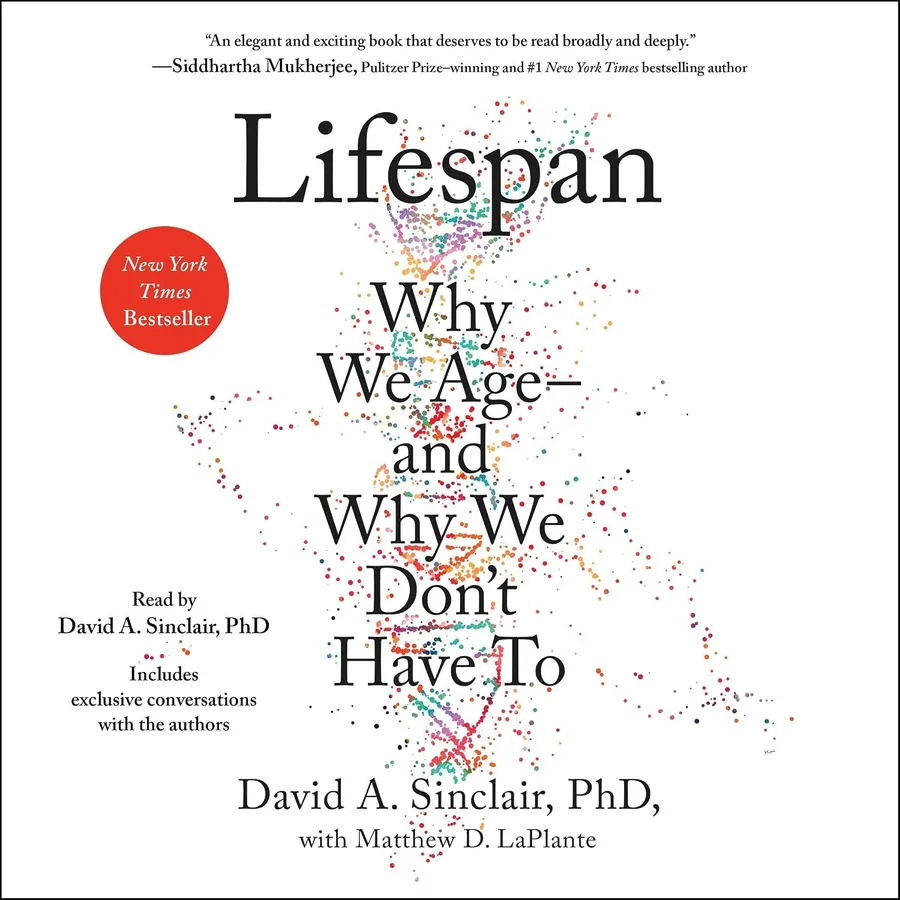
Where to read or listen
- Is there an audiobook of Lifespan: Why We Age, and Why We Don't Have To?
- Yes. Lifespan: Why We Age, and Why We Don't Have To has an Audible audiobook edition, narrated by David Sinclair.Listen free with Audible
We earn from qualifying Amazon purchases.
- How long is the Lifespan: Why We Age, and Why We Don't Have To audiobook?
- The Lifespan: Why We Age, and Why We Don't Have To audiobook runs 11 hr 55 min.
- Is Lifespan: Why We Age, and Why We Don't Have To on Kindle+?
- Yes. Lifespan: Why We Age, and Why We Don't Have To was included with Kindle+ when we last checked on November 23, 2026.
Common questions
- What is Lifespan: Why We Age, and Why We Don't Have To about?
- Lifespan is two books, and the first one is better. The first is a science explainer. David Sinclair, a Harvard Medical School scientist who runs his own lab, sets out an information theory of aging. He puts the main trouble in the epigenome, the layer of chemistry that controls how cells read…
- Is Lifespan: Why We Age, and Why We Don't Have To worth reading?
- We scored Lifespan: Why We Age, and Why We Don't Have To 4.7 out of 5. Lifespan by David Sinclair is a longevity science book from a Harvard Medical School scientist who argues that aging is a treatable disease, not a fixed fate. It explains his theory of why cells age, what his lab work suggests may be possible, and what he does himself.
More like this
Related books

The Comfort Crisis: Embrace Discomfort to Reclaim Your Wild, Happy, Healthy Self
Michael Easter

Exercised: Why Something We Never Evolved to Do Is Healthy and Rewarding
Daniel E. Lieberman

Protocols: An Operating Manual for the Human Body
Andrew D. Huberman

Why We Sleep: Unlocking the Power of Sleep and Dreams
Matthew Walker PhD

Spark: The Revolutionary New Science of Exercise and the Brain
John J. Ratey MD

Breath: The New Science of a Lost Art
James Nestor

The Immortal Life of Henrietta Lacks
Rebecca Skloot

Bigger Leaner Stronger: The Simple Science of Building the Ultimate Male Body
Michael Matthews

When Breath Becomes Air
Paul Kalanithi

Fiber Fueled: The Plant-Based Gut Health Program
Will Bulsiewicz MD