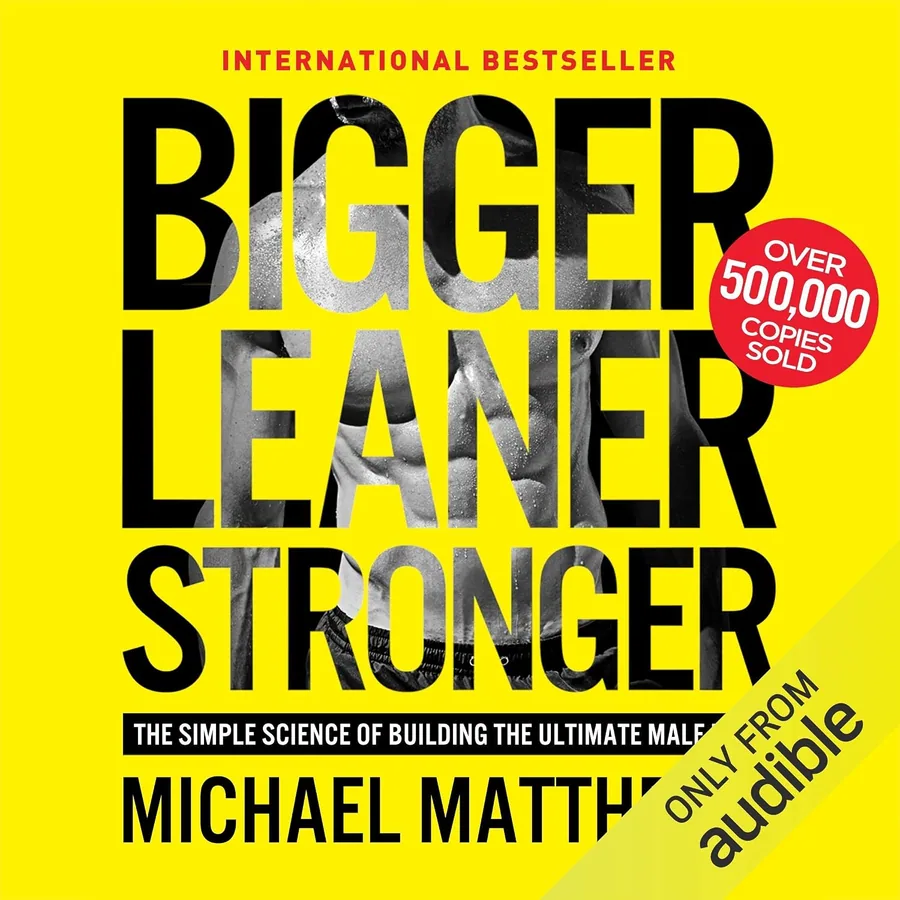
Where to read or listen
- Is there an audiobook of Bigger Leaner Stronger?
- Yes. Bigger Leaner Stronger has an Audible audiobook edition, narrated by Michael Matthews.Listen free with Audible
We earn from qualifying Amazon purchases.
- How long is the Bigger Leaner Stronger audiobook?
- The Bigger Leaner Stronger audiobook runs 14 hr 16 min.
- Is Bigger Leaner Stronger on Kindle+?
- Yes. Bigger Leaner Stronger was included with Kindle+ when we last checked on November 23, 2026.
Common questions
- What is Bigger Leaner Stronger: The Simple Science of Building the Ultimate Male Body about?
- Bigger Leaner Stronger argues that building muscle and losing fat is a simple problem the fitness industry keeps making complicated. Michael Matthews's answer is progressive overload: lift heavy, add weight over time, train three to five hours a week, and eat to a plan instead of by superstition…
- Is Bigger Leaner Stronger: The Simple Science of Building the Ultimate Male Body worth reading?
- We scored Bigger Leaner Stronger: The Simple Science of Building the Ultimate Male Body 4.7 out of 5. Michael Matthews's Bigger Leaner Stronger is a strength training and nutrition book for men who want to build muscle and lose fat on a few hours of lifting a week. It pairs heavy progressive-overload workouts with flexible eating and a twelve-month plan.
More like this
Related books

Lifespan: Why We Age, and Why We Don't Have To
David Sinclair

The Comfort Crisis: Embrace Discomfort to Reclaim Your Wild, Happy, Healthy Self
Michael Easter

Exercised: Why Something We Never Evolved to Do Is Healthy and Rewarding
Daniel E. Lieberman

Fiber Fueled: The Plant-Based Gut Health Program
Will Bulsiewicz MD

The China Study
T. Colin Campbell

Protocols: An Operating Manual for the Human Body
Andrew D. Huberman

The Sports Gene: Inside the Science of Extraordinary Athletic Performance
David Epstein

Why We Sleep: Unlocking the Power of Sleep and Dreams
Matthew Walker PhD

Outlive: The Science and Art of Longevity
Peter Attia MD

Spark: The Revolutionary New Science of Exercise and the Brain
John J. Ratey MD