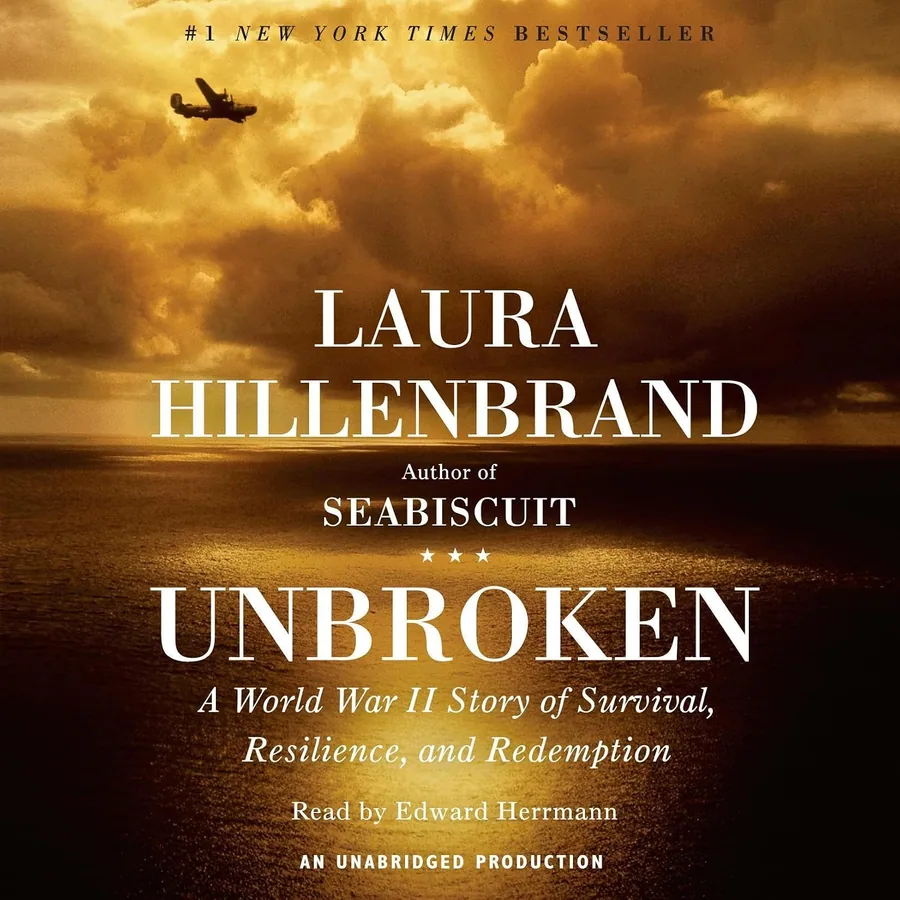
Louie Zamperini has a gift and a habit, and for the first stretch of Unbroken the habit is winning. He's a delinquent in Torrance, California, a petty thief with a turn of speed, and his older brother Pete is the one who works out what to point it at. The boy who runs from trouble becomes a runner, good enough to reach the 1936 Olympics in Berlin, where Hitler shakes his hand. Then the 1940 Olympics are canceled, the war arrives, and the athlete becomes a bombardier on a B-24. Hillenbrand moves through all of this quickly, and the speed is deliberate: she is building a man you'd want back.
Here is the book's argument in one sentence. A person can be driven to the edge of what a body and mind will bear and still keep hold of the self that went in, and the keeping is a daily act of defiance rather than a gift. The evidence is the raft. After the bomber goes into the Pacific on May 27, 1943, only Louie and two others from a crew of nine are alive, and they spend 47 days adrift, circled by sharks, short of food and water, unseen by the planes searching for them. Hillenbrand doesn't dress it up. She lets thirst, starvation and enemy aircraft do the work, and she gives Louie's ingenuity and his dark humor room to breathe, which is why the sequence is bearable to read.
Rescue turns out to be capture. The Japanese take the survivors, and Louie is shipped through a series of prison camps over more than two years, each worse than the last. This is where the book gets harder to read and harder to put down in about equal measure. Hillenbrand gives the scale a number: about 1% of prisoners held on the Atlantic side died in captivity, against 37% in the Pacific. If your WWII reading has been mostly European, this half of the story is unfamiliar ground, and she covers it without turning the camps into spectacle. The cruelty is specific. The guards are sadistic, the men are starved and enslaved, and Louie keeps pushing back. Hope arrives in small doses, enough to keep the pages moving, never enough to let you relax.
What holds all this up is the research, and the research has its own story. Hillenbrand spent seven years on the book. Louie had kept journals, photographs and letters, and she added interviews in both the United States and Japan, much of it by phone, because chronic fatigue syndrome keeps her in bed most days. That context never shows on the page. What shows is the documentation: notes at the end of each chapter, photographs scattered through the text, and enough about the wider war that you always know what was happening on the other side of the world. The facts never stall the story. People who finish it tend to say it reads like a novel and then add, with some disbelief, that none of it was made up.
The postwar stretch is the part I'd argue about. Home is supposed to be the reward, and instead Zamperini comes back with what we'd now call PTSD, nursing the injustices done to him, and his life comes apart. There are pages where you want to shake him. Hillenbrand doesn't flinch from that, and she doesn't rush the turn that follows, an encounter with the evangelist Billy Graham that sets him on a path toward redemption. Readers who don't share his faith will still follow it, because the book treats recovery as the longer fight and makes you believe it.
Why you should read
- Narrative nonfiction about the Pacific theater of World War II
- True survival stories with serious research behind them
- Biographies that read like novels
- Stories of recovery after war
What to expect
- A fast opening before the war turns relentless
- Graphic scenes of starvation and abuse in prison camps
- Notes at the end of each chapter and photographs throughout
- A long postwar section on trauma and faith
Her earlier book, Seabiscuit, followed a famous racehorse. Unbroken finds a whole era inside a man instead, and it asks more of you. At 671 pages it is long, and the length is justified, since the runner, the airman, the castaway, the prisoner and the man who has to live afterward are one person, and the book never lets you forget it.