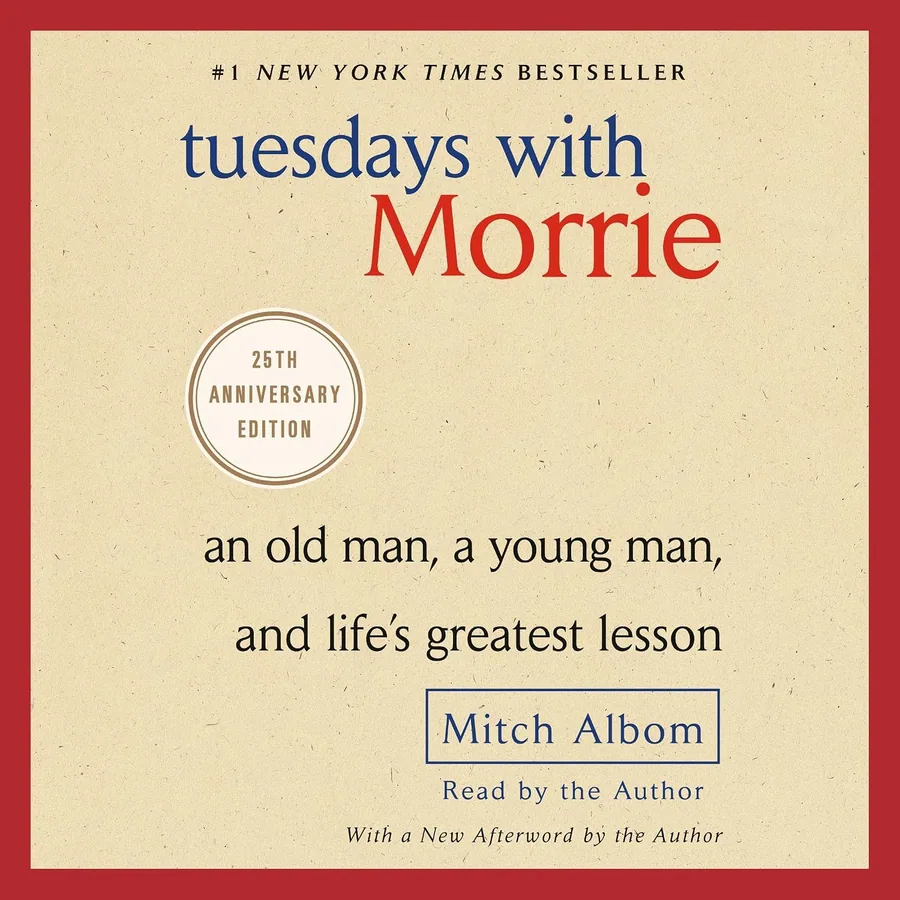
Mitch Albom wants something he can't quite name, and a busy life is in the way. He has lost touch with the college professor who once made the world seem larger, Morrie Schwartz, until he sees the man on television being interviewed by Ted Koppel about living with ALS. Albom goes to see him. One visit turns into a standing Tuesday appointment that lasts until Morrie dies, and Albom shows up each week with a list of subjects he wants to cover, like a student who has been given one more semester.
The book's claim fits in a sentence: a person who looks at death directly gets clearer about everything else, so the dying are the best teachers of the living. What tests that claim is the conversation itself. Each Tuesday has a topic, and between them they cover death, fear, aging, greed, marriage, family, society, forgiveness and what a meaningful life looks like. The structure is a syllabus, and it works as a shape because it keeps the ground moving. Plenty of readers get through it in a day. Morrie's answers are short, concrete and personal, drawn from his own dying rather than from theory, and Albom mostly lets them stand without much commentary, which suits a book that wants you to hear a voice.
The lessons carry unequal weight, and two of them carry most of it. The first is Morrie's idea about emotion. He says you can't detach from pain, grief or love until you have gone all the way into them, because fear is what keeps people stuck. It is a more demanding claim than the usual advice to let things go, and a dying man saying it gives it force. The second is simpler. We need other people at the start of life and at the end, Morrie says, and also in between. That one sends readers off to take stock of who is actually in their corner, which is a decent test of whether a book like this is doing its job.
Albom is both the book's weak point and its smartest device. He stands in for the reader: a man who admits he let society decide what should make him happy, and who spends these months learning to distrust that. Morrie's advice to make a culture of your own, rather than accept the one on offer, is the third idea worth keeping, and it lands because Albom doesn't sell it as a program. He arrives with his list, listens, and gets changed in the slow, unglamorous way people do. The result is a memoir that gives the student's side of the lesson as much room as the teacher's, which keeps it from reading like a lecture transcribed.
The case against the book is a fair one. The lessons are simple, and some readers find them too simple, closer to a sampler of wise sayings than an argument. The format leaves little room for complication, and Morrie is rarely challenged. The hardest feelings, grief and fear among them, are handled in brief passages rather than long ones, and a reader hoping for a deeper dig into any one of them will notice. I'd say the simplicity is a deliberate choice. These are old ideas, and the job here is delivery: a patient man, a willing listener, a clock running down. The ideas are not new. The setting is what makes them hard to wave off.
The pull is emotional too, and the book doesn't hide that. Readers talk about being heartbroken at the end, which is hardly a spoiler for a book that tells you early how it goes. What surprises is the mood of the middle, where Morrie talks about joy, regret and making peace with yourself in the same breath. Readers tend to finish it thinking about what they already have instead of what they lack, which fits the way it works: it turns attention outward, onto the people who are still there.
Why you should read
- Short memoirs about mentors and friendship
- Reflective reads about death, regret and forgiveness
- Book club and gift picks that start conversation
- Anyone wanting a one-sitting, hopeful read
What to expect
- Weekly conversations organized by topic
- Plain, warm prose in a brisk read
- Simple lessons delivered through one friendship
- A sad but gentle ending
That is the best argument the book makes, and it makes it without issuing instructions. Kindness, time and attention are cheap to give and easy to forget, and a slim book about one professor's last months turns out to be good at reminding people. It's short, it's sincere, and it needn't apologize for being either.