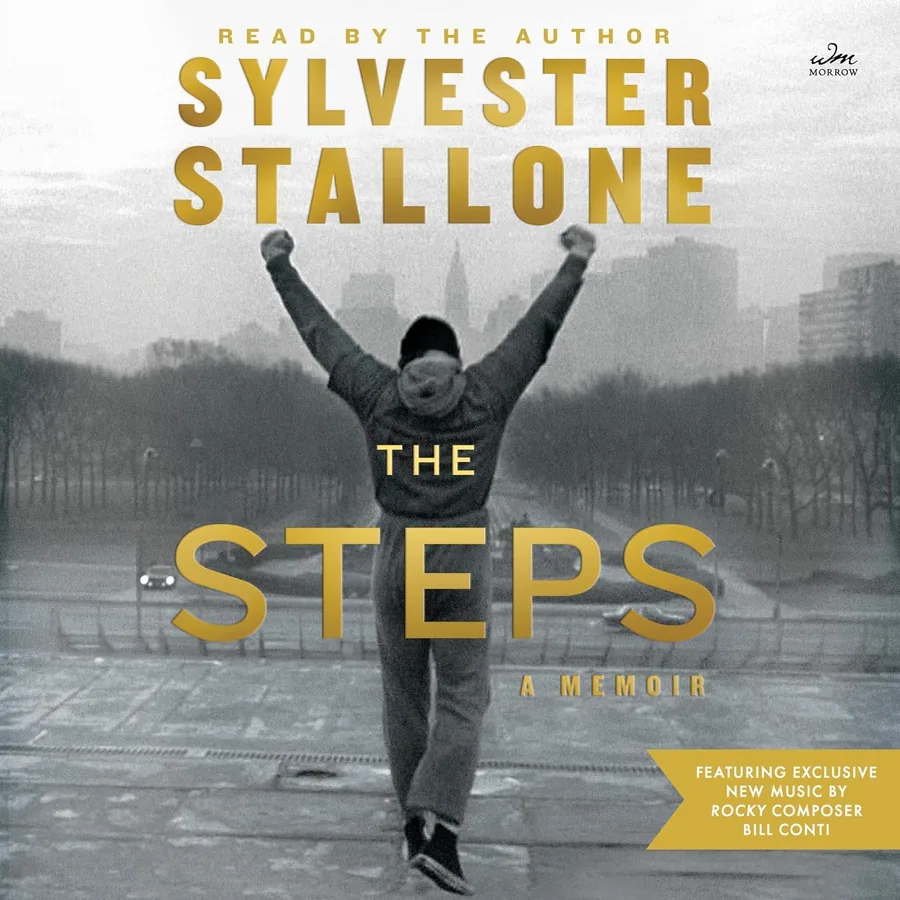
How does a boy nobody wanted to bet on end up bounding up a Philadelphia museum staircase as the most famous underdog in movies? Sylvester Stallone spends 303 pages in The Steps trying to answer that, and the answer he keeps landing on is plain: you get where you're going one step at a time, and you keep taking them when everything says stop.
That is the argument of this celebrity memoir, and the book tests it the way a good memoir should, by showing the cost. The frame is tight. It covers the stretch from 1969, when Stallone landed in New York, to the 1977 Academy Awards night that crowned Rocky, and the years in between are all struggle and subsistence, a young man with no guarantee that persistence will pay off. But he doesn't start there. The first stretch goes back to a difficult birth, an even harder childhood, and school years spent being misunderstood. Anyone who finishes that first part is hooked before Rocky has even entered the picture, and it's easy to see why. The setup is the story.
The childhood material carries the most weight, and it is the strongest evidence for the book's thesis. Stallone writes about his mother with a bluntness that some readers find hard to take, and a few say flatly that they wince at the picture of her. Fair. But the book leans on that portrait because it needs it. Resilience means little if the author can't show you what he was being asked to survive, and the emotional neglect he describes does the explaining that a list of obstacles never could. One reader with a loved one living with PTSD said the book deepened her understanding of that pain, which is a bigger compliment than most memoirs ever collect.
Then comes the Rocky stretch, and here the book gets its propulsion. Anyone who has loved the film will want to know how it got made, and Stallone delivers the passion and the adversity it took to get it onto a screen, and treats it as a story bigger than boxing. He also glances at the later years and the run of iconic roles that followed, though the gravity stays with the lean years. That choice is right. A success story told from the top of the mountain is a victory lap. This one is told from the bottom, with the tone of a man who remembers exactly what it felt like.
The voice deserves its own mention. People who have read it describe the sensation of Sly sitting across from them talking, and the stories are frank, sometimes dark, and funny enough in places to break up the heavy material. It reads fast. Some people took it in a couple of days, others rationed a few chapters a night, and one couple listened on a long drive and found the hours disappearing. Stallone is vulnerable on the page in a way you might not expect from an action icon, and the vulnerability makes the inspirational beats land without the sticky feeling these books usually carry. The "keep punching" ethos could have turned into a poster. Here it stays attached to specific people and specific bad years.
Why you should read
- Rocky fans who want the story behind the story
- Underdog memoirs with a real emotional cost
- Celebrity memoir that reads fast and talks plain
- Anyone who needs a push to keep going
What to expect
- A frank, conversational voice that reads quickly
- A first part rooted in a painful childhood
- Main narrative framed by 1969 through the 1977 Academy Awards
- Some dark stories alongside the humor and heart
If there is a fair caution, one thoughtful reader raised it: dogged self-belief worked for Stallone, and plenty of people who held the same conviction never got the same ending. The book doesn't pretend otherwise so much as set that problem aside, and the spine of it, a wife and family who steadied him and a son who never wrote his parents off, is the most convincing answer it has to luck. That's the part that stuck. The author of one of the great stories about winning spends this book arguing that the harder fight happened off camera.