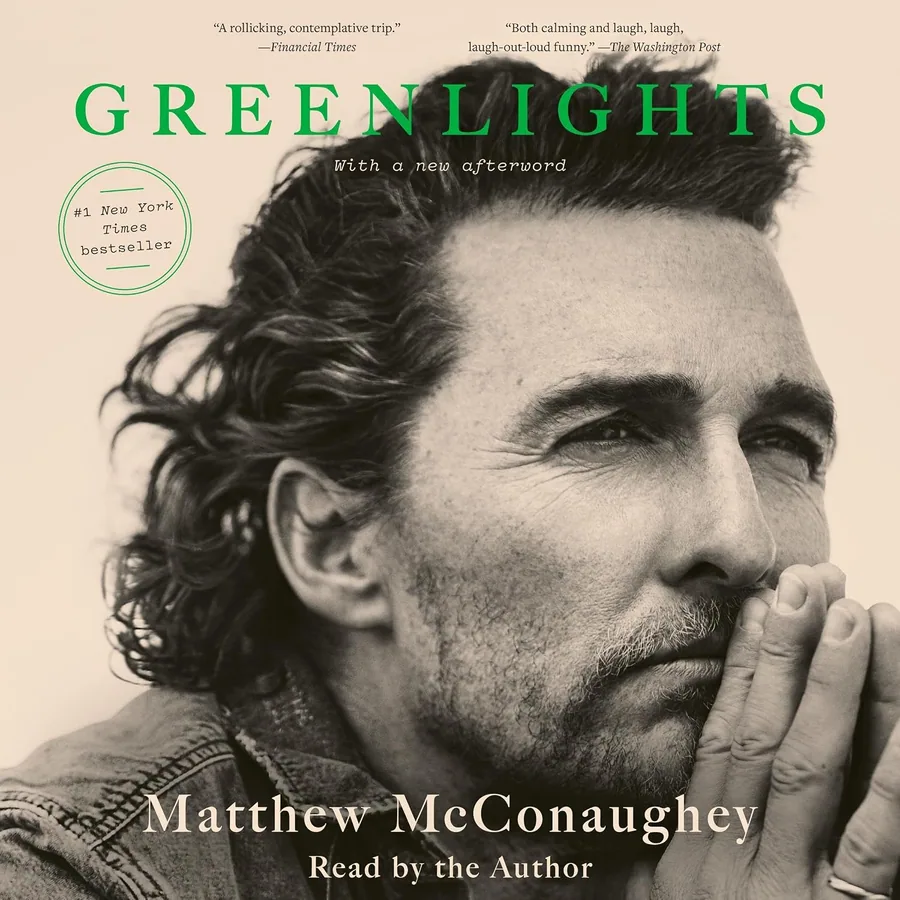
Matthew McConaughey spent forty-two years trying to work out life's riddle, and for thirty-five of them he kept diaries of clues. Greenlights is what he found when he finally sat down with the pile: stories, poems, prayers, photographs and a whole stack of what he calls bumper stickers. He took a one-way ticket to the desert to write it, and the question under every page is practical rather than lofty. How do you live so that life costs you less and gives you more? His answer is an idea he calls catching greenlights, and it is worth stating cleanly before asking whether the book can back it.
Here is the claim in my own words. Most of what stops us is less a wall than a signal we can negotiate with, and a person who learns when to meet the inevitable on its own terms, instead of wrestling it, spends more of life moving. He calls this getting relative with the inevitable. The test of a philosophy like that is whether the author has paid for it, and McConaughey's evidence is his own life, laid out without much varnish.
The chapters about his parents carry the most weight. He grew up in East Texas, in the lower middle class, with parents who divorced and remarried each other twice, with corporal punishment and with money always short. A childhood like that is easy to turn into a grievance. He turns it into respect, and the book's recalibration idea becomes believable at exactly this point, because the thing being recalibrated is something real. A rite of passage involving a brawl with a barroom bouncer follows, and then acting, which he pursues with the work ethic his upbringing gave him.
The success that follows is where a lesser memoir would start gloating. This one gets stranger. He lives opposite to the Hollywood scene, traveling the country with his dog and heading off on expeditions to Africa and South America, and he describes living, spelled without the g, as something bigger than money and comfort. After years of chasing women he settles into a long relationship and fulfills his lifelong wish to be a father. Then comes the choice I'd point to as the best test of the thesis: he walks away from lucrative romantic comedies to chase something more artistic, and he moves home to be near family while he works out the next move. A principle only counts when it costs something, and this one does. The Oscar for Dallas Buyers Club arrives, and he is frank that the popular success he pictured has not fully followed.
The weaker stretches are the ones where the memoir turns into a guide. The aphorisms are punchy and he repeats a few of them, and the slangy voice, with its invented plurals and rolled-together words, can feel like a performance that works harder than it needs to. The charge of narcissism comes up. I don't buy it, because his mother, his wife, his children and his neighbors keep appearing as the reasons behind his choices, but the self-regard is part of the sound, and you'll know within a page if it works for you. The prose suits being read aloud, and at its best it plays like a friend telling you about a long trip.
Why you should read
- Memoirs that double as practical life guides
- Fans of McConaughey's storytelling and acting career
- Readers drawn to philosophy told through anecdotes
- Self-help told with humor and grit
What to expect
- Stories mixed with poems, prayers and bumper-sticker maxims
- A slangy, colorful voice that sounds spoken
- Candid accounts of mistakes and family trouble
- A memoir first and a guide second
What a reader takes away is a method more than a rule: keep notes, wait, and look for the pattern across years. Over 299 pages McConaughey shows that method working on a life with real mess in it, and the claim holds up because the mess stays in the book.