Where to read or listen
- Is there an audiobook of Into Thin Air?
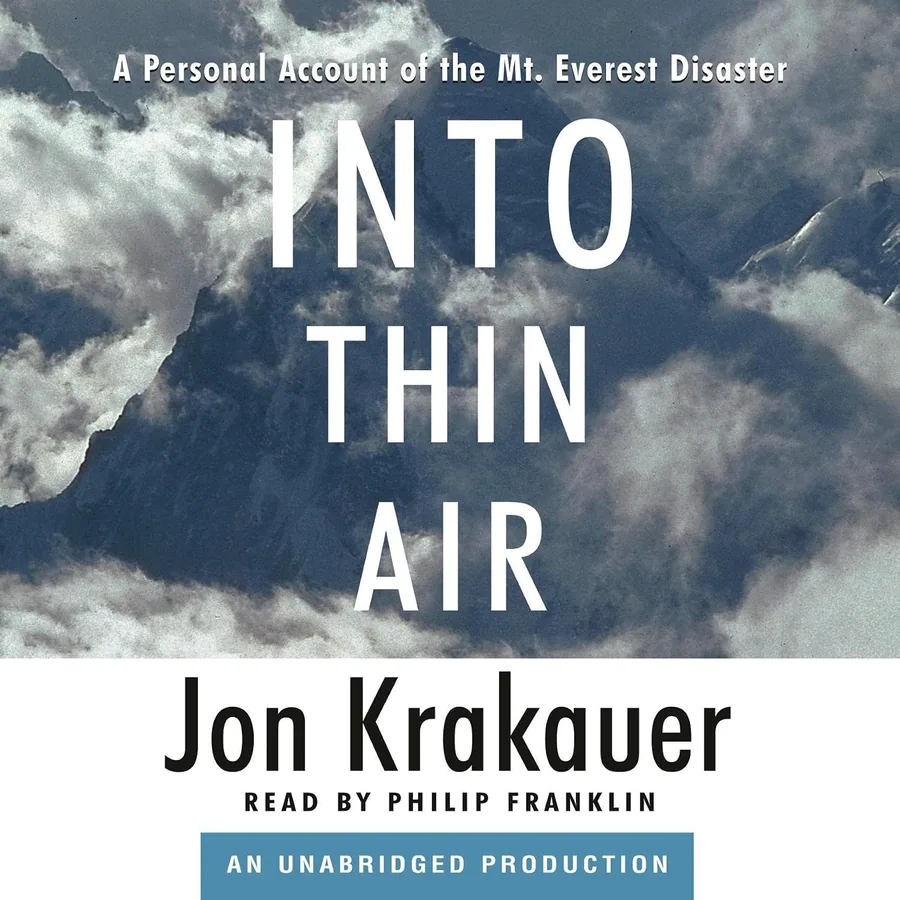
- Yes. Into Thin Air has an Audible audiobook edition, narrated by Philip Franklin.Listen free with Audible
We earn from qualifying Amazon purchases.
- How long is the Into Thin Air audiobook?
- The Into Thin Air audiobook runs 9 hr 8 min.
- Is Into Thin Air on Kindle+?
- No. Into Thin Air was not included with Kindle+ when we last checked on November 23, 2026.
More by Jon KrakauerSee every Jon Krakauer book we've reviewed, with our scores.All Jon Krakauer books →
Common questions
- What is Into Thin Air about?
- Into Thin Air reads the way a bad dream feels while you're still inside it. You know roughly where it is going, and that makes the whole approach heavier. Jon Krakauer, a journalist sent up Everest with a guided expedition to report on how commercial the mountain had become, reached the summit on…
- Is Into Thin Air worth reading?
- We scored Into Thin Air 4.4 out of 5. Jon Krakauer's Into Thin Air is a mountaineering book about the deadly 1996 Everest storm, told by the journalist who was on the mountain that day. It moves fast, argues hard about blame, and shows how ordinary mistakes stack up at altitude.
More like this
Related books

The Pirate Queen
Ariel Lawhon

The Tapestry of Fate
Shannon Chakraborty

Treasure Island
Robert Louis Stevenson

Lonesome Dove
Larry McMurtry

MEG: A Novel of Deep Terror
Steve Alten

Endure: Mind, Body, and the Curiously Elastic Limits of Human Performance
Alex Hutchinson

Eleven Rings: The Soul of Success
Phil Jackson

Eat and Run: My Unlikely Journey to Ultramarathon Greatness
Scott Jurek

Expensive Basketball
Shea Serrano

A Walk in the Park: The True Story of a Spectacular Misadventure in the Grand Canyon
Kevin Fedarko