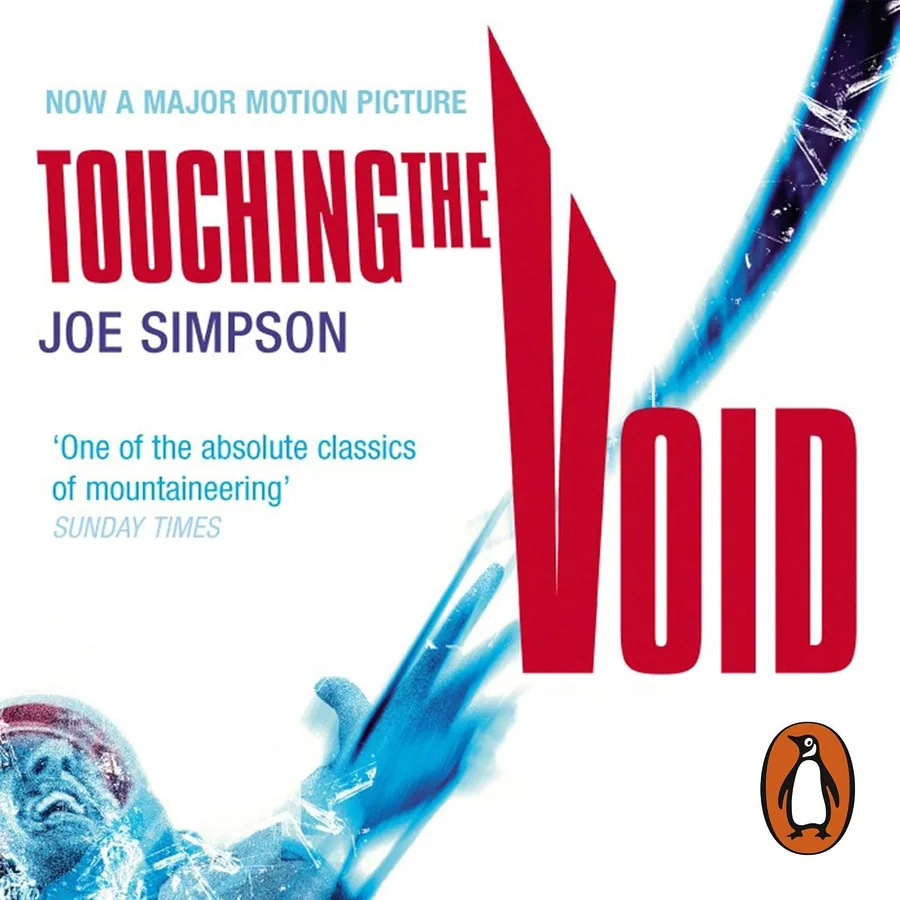
Where to read or listen
- Is there an audiobook of Touching the Void?
- Yes. Touching the Void has an Audible audiobook edition, narrated by Andrew Wincott and Daniel Weyman.Listen free with Audible
We earn from qualifying Amazon purchases.
- How long is the Touching the Void audiobook?
- The Touching the Void audiobook runs 6 hr 52 min.
- Is Touching the Void on Kindle+?
- No. Touching the Void was not included with Kindle+ when we last checked on November 23, 2026.
Common questions
- What is Touching the Void about?
- What do two climbers owe each other when one of them is, by every sensible measure, already dead? Touching the Void keeps that question under every page, and it's the reason the book lasts beyond its thrills. In 1985 a pair of young, stubborn climbers went to the Peruvian Andes after a route…
- Is Touching the Void worth reading?
- We scored Touching the Void 4.5 out of 5. Touching the Void is Joe Simpson's first-person mountaineering memoir of a 1985 climb in the Peruvian Andes that ended in a broken leg, a cut rope, and a survival story few believed possible. Tense, painful, and morally knotty, it's a classic of survival writing.
More like this
Related books

Expensive Basketball
Shea Serrano

Swan Song: Diana, My Sister
Charles Spencer

A Walk in the Park: The True Story of a Spectacular Misadventure in the Grand Canyon
Kevin Fedarko

Educated
Tara Westover

A Rumor of War
Philip Caputo

Lone Survivor: The Eyewitness Account of Operation Redwing and the Lost Heroes of SEAL Team 10
Marcus Luttrell

The Seven Storey Mountain
Thomas Merton

The Boys in the Boat: Nine Americans and Their Epic Quest for Gold at the 1936 Berlin Olympics
Daniel James Brown

Kitchen Confidential: Adventures in the Culinary Underbelly
Anthony Bourdain

You with the Sad Eyes
Christina Applegate