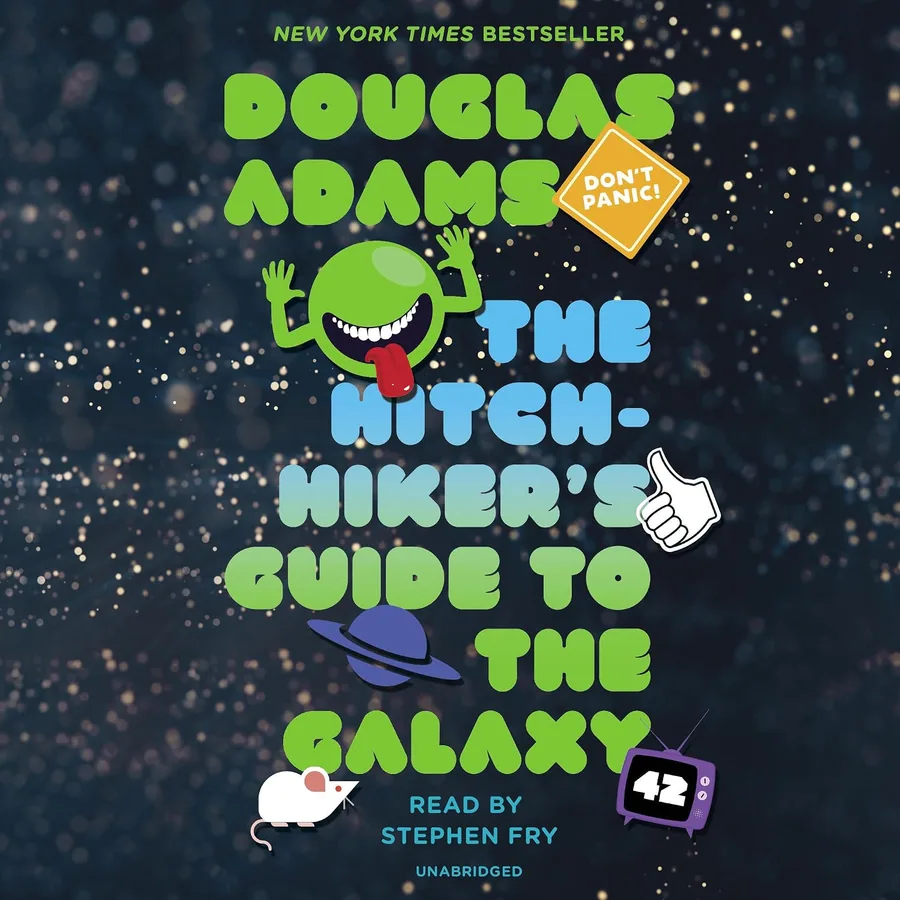
This is the funniest way anyone has ever blown up the planet, and it has almost no plot to speak of. Both of those things are true, and the book knows it. Arthur Dent is a stubborn, befuddled Englishman standing in London watching his house get knocked down, and he has barely finished complaining about that when his friend Ford Prefect delivers worse news. The Earth is about to go too, cleared away to make room for a galactic freeway. Ford has spent fifteen years on the planet posing as an out-of-work actor. He is actually a researcher for the revised edition of a guidebook called The Hitchhiker's Guide to the Galaxy, and he gets Arthur off the ground with seconds to spare.
Here's the part I love, and I mean love, with my hands in the air: the universe in this book runs on paperwork. Nobody destroys Earth out of malice. Intergalactic civil servants do it because the plan was filed, and the cost of that indifference lands entirely on Arthur, a man whose planet is erased as an administrative detail. Ford beams the two of them onto the mothership of the Vogon demolition fleet, where they meet ruthless bureaucrats, murdered mattresses and a punishment by poetry that is exactly as bad as it sounds. Then they are thrown into space. Twenty-nine seconds later, one short of the end, they are picked up by the Heart of Gold, a stolen ship whose crew includes Zaphod Beeblebrox, a two-headed, three-armed ex-hippie who happens to be president of the galaxy, and Trillian, a woman Arthur once tried to chat up at a party.
Adams doesn't bother making that sequence plausible. The ship runs, when it runs at all, on the Infinite Improbability Drive, and the plot behaves accordingly: wherever the story needs to go, it goes, and the odds can be dealt with later. Some readers will find this discombobulating, and they're not wrong. There are about twenty things happening at once, the structure takes a while to show itself, and it can feel as though the book has no direction. I'd say the lack of direction is the engine. It lets Adams spend his energy on the thing he does better than almost anyone, which is the aside.
The asides come as entries from the Guide itself, scattered through the story, packed with tidbits about the universe that are never essential and always funny. Towels are, according to the Guide, the single most useful thing an interstellar hitchhiker can carry. There is a drink called the Pan Galactic Gargle Blaster. Ford, stuck on Earth for fifteen years, never managed to update the entry on our planet beyond a two-word verdict, and the verdict is a masterpiece of understatement. Those entries do the work of a whole world, a sprawling and ridiculous galaxy, without a page of map or lore.
The cast is a treat. Arthur is the one ordinary human in the room and mostly the butt of the joke, always confused, always asking the question the audience would ask. Zaphod is gloriously out to lunch, and the book makes a sharp joke about what a president of the galaxy is actually for. Then there's Marvin, a paranoid, brilliant and chronically depressed robot, who nearly steals the book by sighing at it. Even the minor appearances are strange in the best way. One former graduate student is obsessed with the disappearance of every ballpoint pen he ever bought. That's a whole character, and it takes a paragraph.
As for the satire, it goes after bureaucracy, politics and religion, and it comes at them sideways rather than with a lecture. The sentences keep sliding out from under you, so that nothing quite means what you expect, and by the end the idea that life must add up to something looks like the biggest joke on the table. Readers who want a tightly plotted space adventure will keep waiting for the story to behave. It won't. People who pick it up expecting a joke book find, somewhat to their surprise, that it also gets them looking at their own planet and the odd life on it from a new angle.
Why you should read
- Absurdist science fiction comedy
- Satire of bureaucracy, politics and religion
- Short, quotable classics
- Readers who enjoy British dry humor
What to expect
- Random, rapid-fire jokes over a loose plot
- Entries from the Guide scattered through the story
- A relatable human lost among strange aliens
- A very short read
At 208 pages it is short, and it moves fast enough to read in an afternoon. Adams spends all of it insisting that none of this makes sense, and the insistence is built so carefully, and with such affection for the species he has just demolished, that you finish grateful.