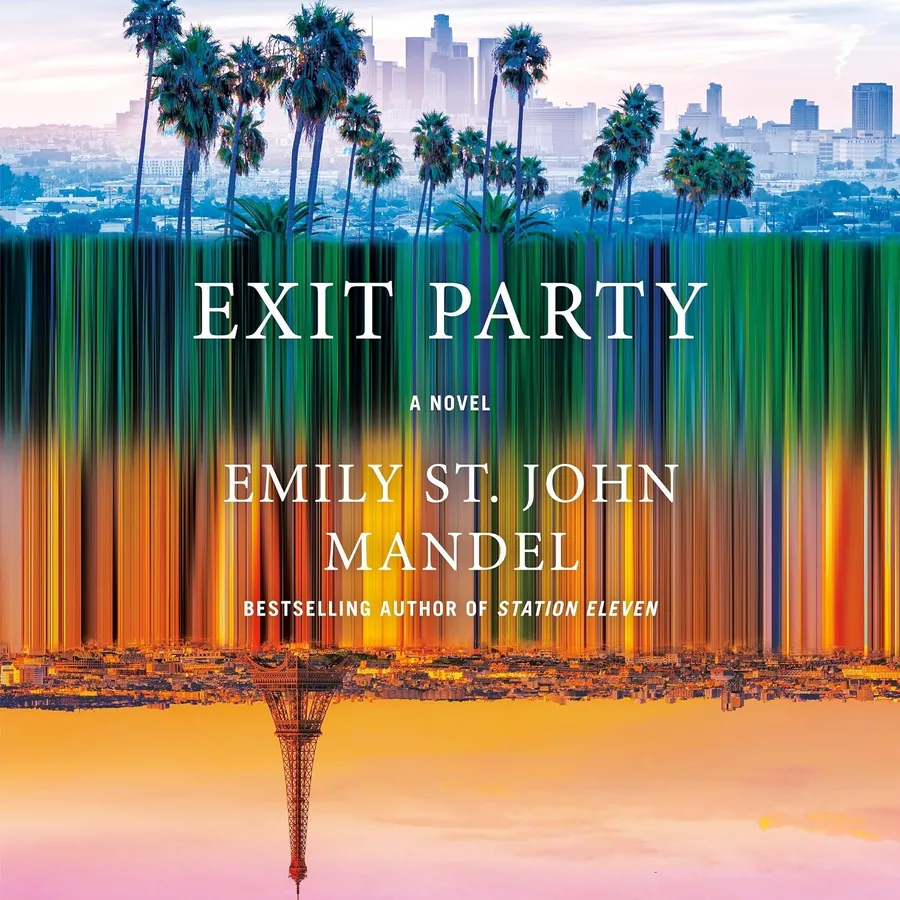
Where to read or listen
- Is there an audiobook of Exit Party?
- Yes. Exit Party has an Audible audiobook edition, narrated by Kirsten Potter, Kimberly Farr, Peter Ganim, Catherine Ho, and James Aaron Oh.Listen free with Audible
We earn from qualifying Amazon purchases.
- How long is the Exit Party audiobook?
- The Exit Party audiobook runs 12 hr 29 min.
- Is Exit Party on Kindle Unlimited?
- No. Exit Party was not included with Kindle Unlimited when we last checked on October 9, 2026.
- What formats is Exit Party available in?
- On Amazon, Exit Party comes as a Kindle ebook, a paperback and a hardcover.
More by Emily St. John MandelSee every Emily St. John Mandel book we've reviewed, with our scores.All Emily St. John Mandel books →
Common questions
- What is Exit Party about?
- The troops leave, the curfew ends, and the first thing Los Angeles does with its freedom is throw a party. In Exit Party, Emily St. John Mandel's literary science fiction novel, the year is 2031, the United States has come apart, and Ari Waker walks across Silverlake to an apartment full of people…
- Is Exit Party worth reading?
- We scored Exit Party 4.5 out of 5. Emily St. John Mandel's Exit Party is a literary science fiction novel about a 2031 Los Angeles party where the host disappears and a bewildered double wanders out of the crowd. It travels from a splintered America to Greece, Paris and the moon, and finds a surprising amount of…
Advertisement
More like this
Related books

We Burned So Bright
TJ Klune

Under Story
Chloe Benjamin

Cool Machine
Colson Whitehead

Green City Wars
Adrian Tchaikovsky

John of John: A Novel
Douglas Stuart

Into the Blue: A Love Story
Emma Brodie

The Things We Never Say
Elizabeth Strout

Platform Decay
Martha Wells

My Friends
Fredrik Backman

The Last Contract of Isako
Fonda Lee