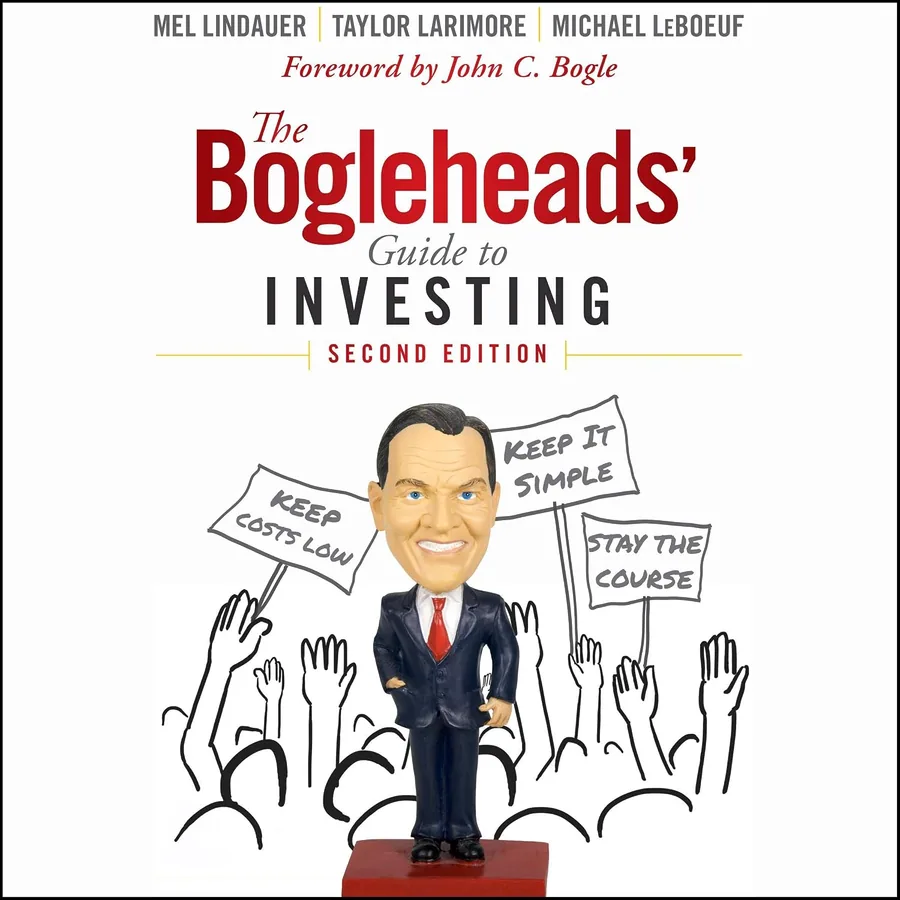
Where to read or listen
- Is there an audiobook of The Bogleheads' Guide to Investing?
- Yes. The Bogleheads' Guide to Investing has an Audible audiobook edition, narrated by Barry Abrams.Listen free with Audible
We earn from qualifying Amazon purchases.
- How long is the The Bogleheads' Guide to Investing audiobook?
- The The Bogleheads' Guide to Investing audiobook runs 10 hr 3 min.
- Is The Bogleheads' Guide to Investing on Kindle+?
- No. The Bogleheads' Guide to Investing was not included with Kindle+ when we last checked on November 23, 2026.
Common questions
- What is The Bogleheads' Guide to Investing about?
- The Bogleheads' Guide to Investing sells the least exciting plan in finance, and sells it with a sense of humor. Taylor Larimore, Mel Lindauer, and Michael LeBoeuf write for the do-it-yourself investor, drawing on the thinking of John C. Bogle and the long-running Bogleheads.org forum community…
- Is The Bogleheads' Guide to Investing worth reading?
- We scored The Bogleheads' Guide to Investing 4.8 out of 5. The Bogleheads' Guide to Investing by Taylor Larimore, Mel Lindauer, and Michael LeBoeuf is a plain-spoken personal finance and index investing handbook built on the ideas of John C. Bogle. It lays out a low-cost, buy-and-hold approach for people who would rather understand…
More like this
Related books

The Automatic Millionaire: A Powerful One-Step Plan to Live and Finish Rich
David Bach

Rich Dad Poor Dad: What the Rich Teach Their Kids About Money That the Poor and Middle Class Do Not!
Robert T. Kiyosaki

The Little Book of Common Sense Investing
John C. Bogle

Rich Dad's CASHFLOW Quadrant: Rich Dad's Guide to Financial Freedom
Robert T. Kiyosaki

The Intelligent Investor: The Definitive Book on Value Investing
Benjamin Graham

The Total Money Makeover: A Proven Plan for Financial Peace
Dave Ramsey

A Random Walk Down Wall Street
Burton G. Malkiel

The Simple Path to Wealth: Your Road Map to Financial Independence and a Rich, Free Life
JL Collins

I Will Teach You to Be Rich
Ramit Sethi

The Richest Man in Babylon
George S. Clason