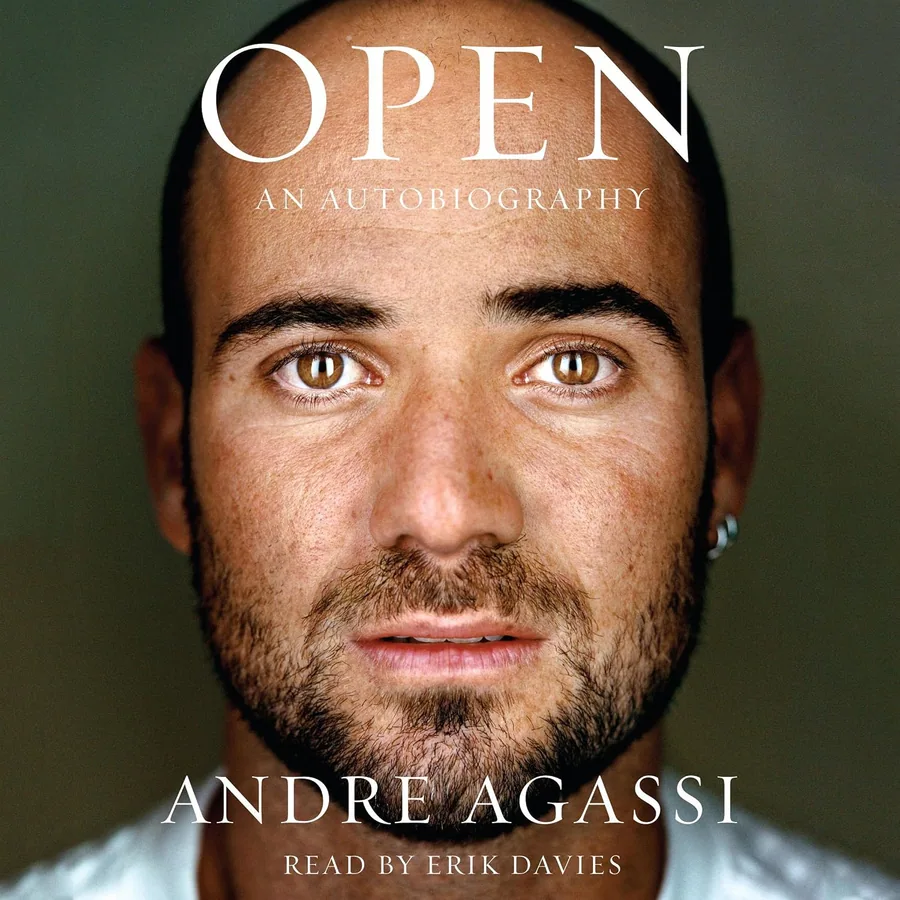
Second round of the 2006 US Open. Andre Agassi's body is failing, the opponent across the net is someone you've never heard of, and he is fighting that player, his own body and a game he says he hates, all at once. Open starts there, late in his career rather than at the start of his life, and it's a smart place to stand. Everything the rest of the book explains is already on the court.
Here's the argument, stated plainly. Agassi spent his life becoming the person other people needed him to be, and a sports memoir can only be as honest as its author is willing to be about that. He is willing. The book's central claim is that the dedicated champion the world saw was a construction: a father who was moody and demanding picked the sport before his son could choose anything, a team later picked the goals, and Agassi went along while rebelling against the image they had made. The evidence for that claim is the life itself, and Agassi lays it out without much self-defense.
The father is the strongest material. The pressure he put on the family was heavy enough that Agassi's siblings came to hate tennis too, and the book treats that fact as a family story rather than a footnote to a famous career. His love and his control are tangled together, and the memoir doesn't try to untie them for you. Readers who finished it tend to say the same thing: the family relationships hold up against any match in the book. I agree. The tennis would be impressive without them, but it wouldn't mean as much.
Then the career, which the book walks through point by point. Eight Grand Slams, the first by twenty-two. Money, celebrity, and an awkward relationship with both. The long hair and denim shorts at Wimbledon are in here, and so is the fun he was having more often than the myth allows. There's a romance with Steffi Graf, a marriage to Brooke Shields, and a team around him whose camaraderie comes through. Agassi writes in the present tense, which keeps the old matches and old humiliations from settling into anecdote. You're in the moment with him rather than looking back at it.
That approach has a cost, and it's a fair one to name. The book is 547 pages, and a lot of it is tennis: points, scores, the shop talk of a sport with its own jargon. A reader with no feel for the game will still find plenty, because the people and the pressure carry the story. Even so, there are stretches of match play that ask for patience, and the length gives the book room to be honest at the expense of speed.
The rewards for that patience come late. The memoir's emotional payoff arrives deep into the book, after a long run of matches, injuries and unhappiness. When it comes, it reframes him. His hatred of tennis stops sounding like ingratitude and starts sounding like a person who never got to ask what he wanted. Readers who came in knowing little about him say it left them fond of him, and I can see why.
What sets Open apart from the usual retired-star book is how little it flatters its subject. The common failure in the genre is the memoir that tidies a career into a victory lap. This one keeps the injuries, the confusion and the unhappiness in view, and it lets the success look strange next to them. It treats winning as something that happened to a man who wanted something else.
Why you should read
- Sports memoir fans who want candor over victory laps
- Readers drawn to demanding-parent family stories
- Tennis followers who remember Agassi's career
- Memoir readers with no tennis background but patience for long books
What to expect
- A long book at 547 pages, heavy on match detail
- Present-tense narration that puts you inside old matches
- Opens at the 2006 US Open, then goes back to childhood
- Emotional payoff arrives late
The book is long, candid and very good. Agassi puts the match, the father and the doubt on the same page, and the opening scene reads differently once you know what he was carrying onto the court.