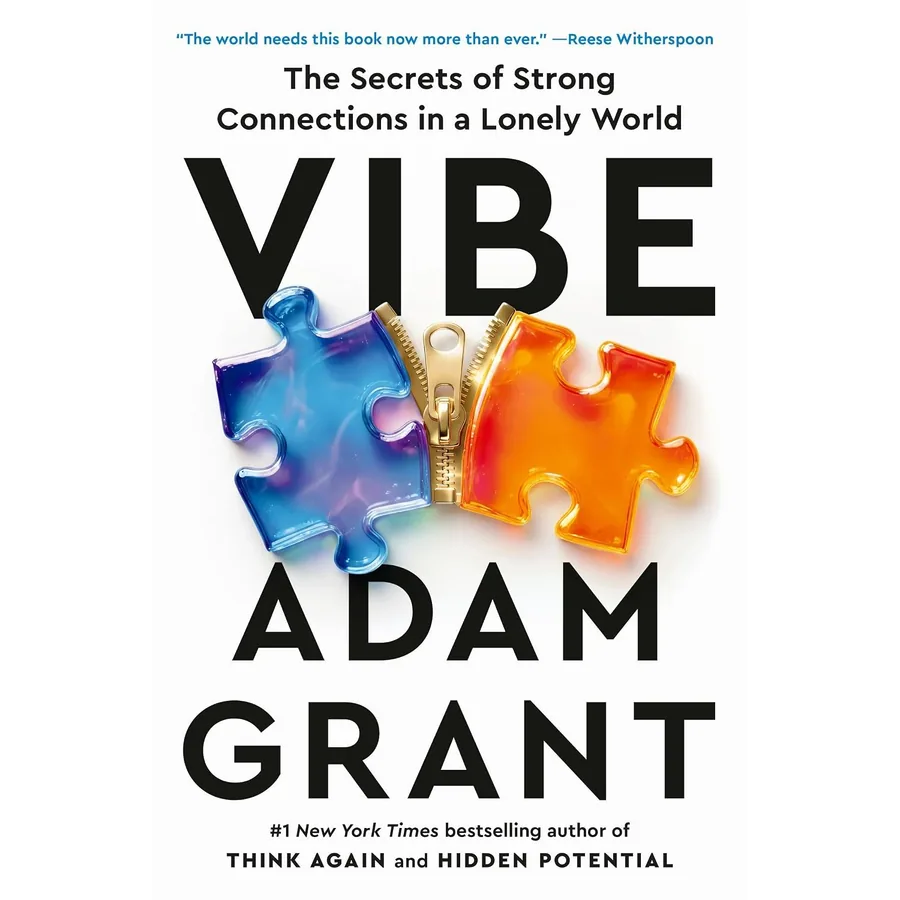
Where to read or listen
- Is there an audiobook of Vibe: The Secrets of Strong Connections in a Lonely World?
- Yes. Vibe: The Secrets of Strong Connections in a Lonely World has an Audible audiobook edition, narrated by Adam Grant and a full cast.Listen free with Audible
We earn from qualifying Amazon purchases.
- How long is the Vibe: The Secrets of Strong Connections in a Lonely World audiobook?
- The Vibe: The Secrets of Strong Connections in a Lonely World audiobook runs 6 hr 48 min.
- Is Vibe: The Secrets of Strong Connections in a Lonely World on Kindle+?
- No. Vibe: The Secrets of Strong Connections in a Lonely World was not included with Kindle+ when we last checked on November 16, 2026.
- What formats is Vibe: The Secrets of Strong Connections in a Lonely World available in?
- On Amazon, Vibe: The Secrets of Strong Connections in a Lonely World comes as a Kindle ebook, a paperback and a hardcover.
Common questions
- What is Vibe: The Secrets of Strong Connections in a Lonely World about?
- Some people you click with in five minutes. Others take years, and a few never happen at all. Adam Grant starts from that everyday puzzle and asks whether chemistry is a fixed trait or something you can build. Vibe: The Secrets of Strong Connections in a Lonely World is his answer, and the answer…
- Is Vibe: The Secrets of Strong Connections in a Lonely World worth reading?
- We scored Vibe: The Secrets of Strong Connections in a Lonely World 4.6 out of 5. Vibe: The Secrets of Strong Connections in a Lonely World is Adam Grant's psychology book on why some people click and others don't, and what anyone can do to build closer friendships, family ties, and workplace bonds. Research-backed, story-heavy, and more personal than his…
More like this
Related books

Attached: The New Science of Adult Attachment and How It Can Help You Find--and Keep--Love
Amir Levine

Hold Me Tight: Seven Conversations for a Lifetime of Love (The Dr. Sue Johnson Collection, 1)
Dr. Sue Johnson EdD

Tiny Habits: The Small Changes That Change Everything
BJ Fogg PhD

Range: Why Generalists Triumph in a Specialized World
David Epstein

Outliers: The Story of Success
Malcolm Gladwell

Mindset: The New Psychology of Success
Carol S. Dweck

The Body Keeps the Score: Brain, Mind, and Body in the Healing of Trauma
Bessel van der Kolk M.D.

Lost Connections
Johann Hari

How to Talk So Kids Will Listen & Listen So Kids Will Talk (The How To Talk Series)
Adele Faber

The Whole-Brain Child: 12 Revolutionary Strategies to Nurture Your Child's Developing Mind
Daniel J. Siegel M.D.