Where to read or listen
- Is there an audiobook of The Vanishing Family?
- Yes. The Vanishing Family has an Audible audiobook edition, narrated by Sean Pratt.Listen free with Audible
We earn from qualifying Amazon purchases.
- How long is the The Vanishing Family audiobook?
- The The Vanishing Family audiobook runs 10 hr 57 min.
- Is The Vanishing Family on Kindle+?
- No. The Vanishing Family was not included with Kindle+ when we last checked on October 26, 2026.
- What formats is The Vanishing Family available in?
- On Amazon, The Vanishing Family comes as a Kindle ebook, a paperback and a hardcover.
More by Robert KolkerSee every Robert Kolker book we've reviewed, with our scores.All Robert Kolker books →
Common questions
- What is The Vanishing Family: Love, Fate, and the Quest to End Dementia about?
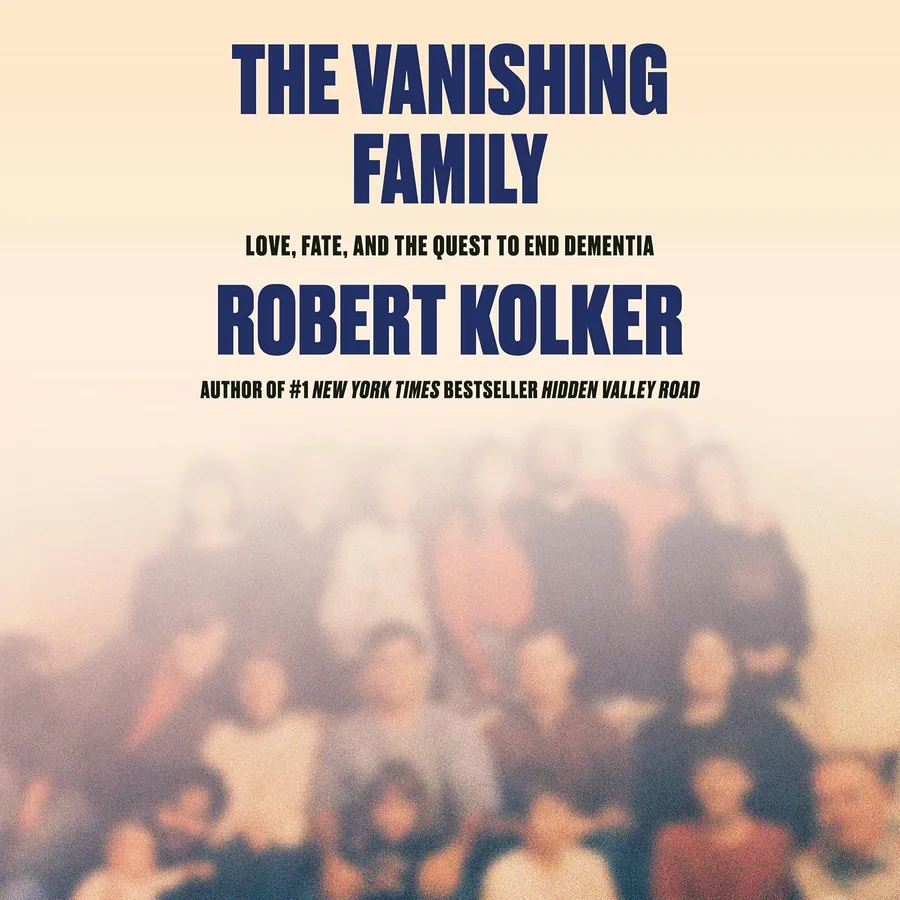
- A mother in Pleasant Hills, Pennsylvania, still young and beautiful, turns withdrawn and neglectful, and only her youngest daughter, Barb, is home to watch it happen. The other eight children have gone off to college and lives of their own. The Vanishing Family, by Robert Kolker, who wrote Hidden…
- Is The Vanishing Family: Love, Fate, and the Quest to End Dementia worth reading?
- We scored The Vanishing Family: Love, Fate, and the Quest to End Dementia 4.6 out of 5. The Vanishing Family by Robert Kolker, the author of Hidden Valley Road, is narrative science nonfiction about a Pennsylvania family of nine siblings carrying an inherited form of dementia. It braids a household's slow unraveling with the hunt for a cure, and it is hard to read…
More like this
Related books

Hidden Valley Road
Robert Kolker

Protocols: An Operating Manual for the Human Body
Andrew D. Huberman

Take Me to Your Leader: Perspectives on Your First Alien Encounter
Neil deGrasse Tyson

The Big Short: Inside the Doomsday Machine
Michael Lewis

Thinking, Fast and Slow
Daniel Kahneman

Braiding Sweetgrass: Indigenous Wisdom, Scientific Knowledge and the Teachings of Plants
Robin Wall Kimmerer

Why We Sleep: Unlocking the Power of Sleep and Dreams
Matthew Walker PhD

Spark: The Revolutionary New Science of Exercise and the Brain
John J. Ratey MD

In Defense of Food: An Eater's Manifesto
Michael Pollan

The Omnivore's Dilemma: A Natural History of Four Meals
Michael Pollan