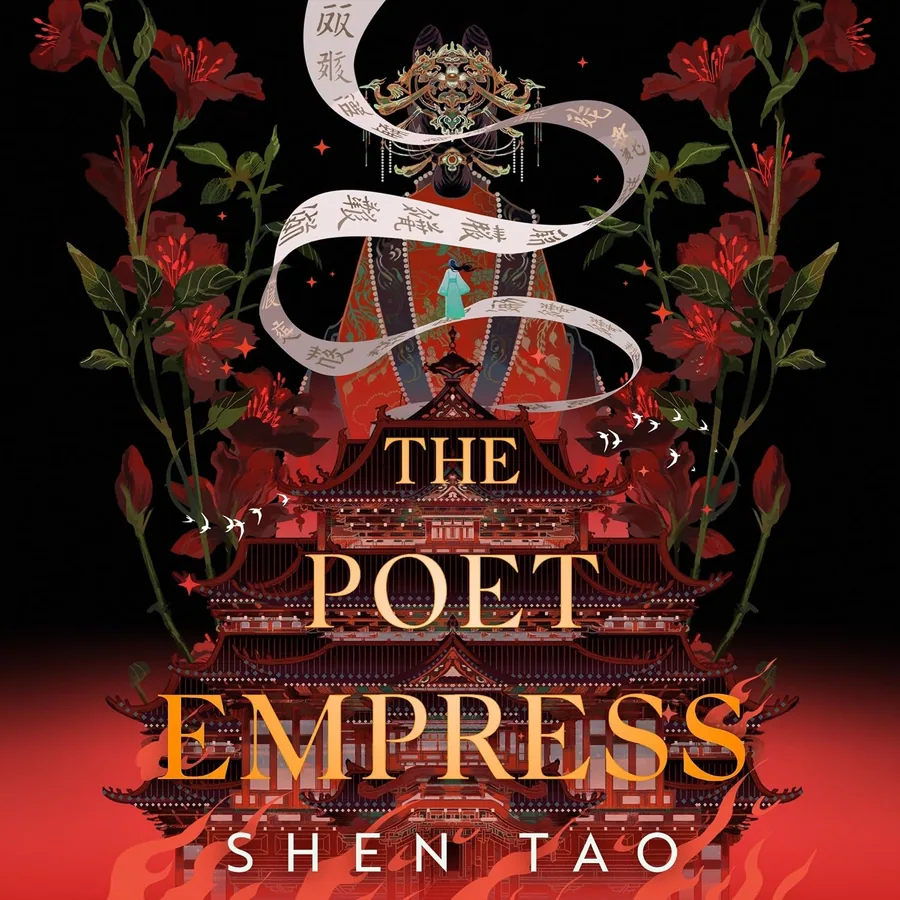
Here is the rule that makes The Poet Empress hum. In this empire, magic is poetry, poetry requires literacy, and women are forbidden to read. Stack those three facts on top of each other and you get a power structure that runs on enforced ignorance, a whole civilization built to keep half its people from the one skill that could arm them. Shen Tao never lectures you about any of it. She lets you feel it the first time Wei Yin, who taught herself letters in secret at enormous risk, shapes a handful of stolen words into something that bends the world, and realizes in the same breath that being caught knowing them could get her killed. Worldbuilding as a loaded weapon. I was hooked from that scene forward.
Wei Yin does not begin dangerous. She begins desperate. Her family is starving in the waning years of the Azalea Dynasty, the emperor dying, the land hollowed out by famine, and after burying a fifth sibling she does the only thing left to her: she offers herself as a concubine to the heir of Azalea House, a beautiful and vicious place ruled by a beautiful and vicious prince. In most fantasy that would be the low point the heroine spends the book escaping. Shen Tao treats it as the forge. Inside those walls, with the palace balanced on the knife-edge of civil war, Wei has to learn faster and read the room harder than the people who believe they own her.
I'll be straight about the tone, because the book is. This is dark fantasy and it does not flinch. The prince is genuinely cruel, the court runs on coercion and fear, and Shen Tao attaches a content note up front for real reasons. She is never cruel for spectacle, though. The violence is the physics of a world where a starving girl's only leverage is her body and her hidden mind, and every ugly turn sharpens the question humming under the whole novel: what does survival make of a person, and is the thing it makes still worth being? Wei keeps answering it, and her answers keep getting harder to live with.
The poetry magic is the finest invention on offer, and Shen Tao keeps discovering new corners of it. Spells are composed, which means they can be graceful or clumsy, sincere or deceitful, and the better poet wins the exchange. That single idea pays off again and again: a duel here is two people trying to out-write each other under lethal pressure, and it is thrilling in a way clanging swords rarely manage. Watching Wei grow from someone hoarding forbidden syllables in the dark into someone who can build a working spell in front of enemies who would execute her for the attempt is the pure, repeatable pleasure of the book. The system has a real cost and a real logic, and Shen Tao respects both. Nobody waves a hand and fixes things. Power here is literacy plus nerve plus the willingness to be seen doing the impossible thing you were forbidden to learn.
The court around Wei earns its intrigue, too. Alliances shift on a held glance, servants trade in information because it's the only currency they're allowed, and Shen Tao is careful to give even the monsters a logic you can follow. The politics never turn into a lore dump. They stay human-sized, decided in rooms by frightened, ambitious people, which is exactly why the stakes land. When the civil war finally starts breathing down the palace's neck, you feel it as pressure on specific people you've come to care about, not as armies on a map.
The prose leans lush and image-heavy, occasionally almost too rich, though it fits an empire that treats the beauty of words as the highest form of power. Readers who loved She Who Became the Sun will recognize the ambition, a marginalized figure clawing toward the throne in an imperial Chinese-inspired world, and anyone who admired the moral seriousness of R.F. Kuang will find the same refusal to let triumph arrive clean and cost-free. For a debut, the control is startling. Shen Tao is clearly building toward something large and never once loses the thread.
Why you should read
- Fans of She Who Became the Sun and R.F. Kuang
- Dark, literary epic fantasy with real stakes
- Imperial Chinese-inspired worldbuilding
- Inventive magic systems with rules and costs
What to expect
- A poetry-based magic system, richly developed
- Dark themes with an author content note
- Palace intrigue and looming civil war
- Lush, image-forward prose
By the final stretch, the girl who once risked death to read a single line is composing the most dangerous poem in the empire, and the book has made its central argument plain: the thing a system works hardest to withhold from you is precisely the thing that could bring the system down. I finished it and wanted the next volume in my hands immediately. Give me more of this world, and much more of whatever Wei Yin is becoming inside it.