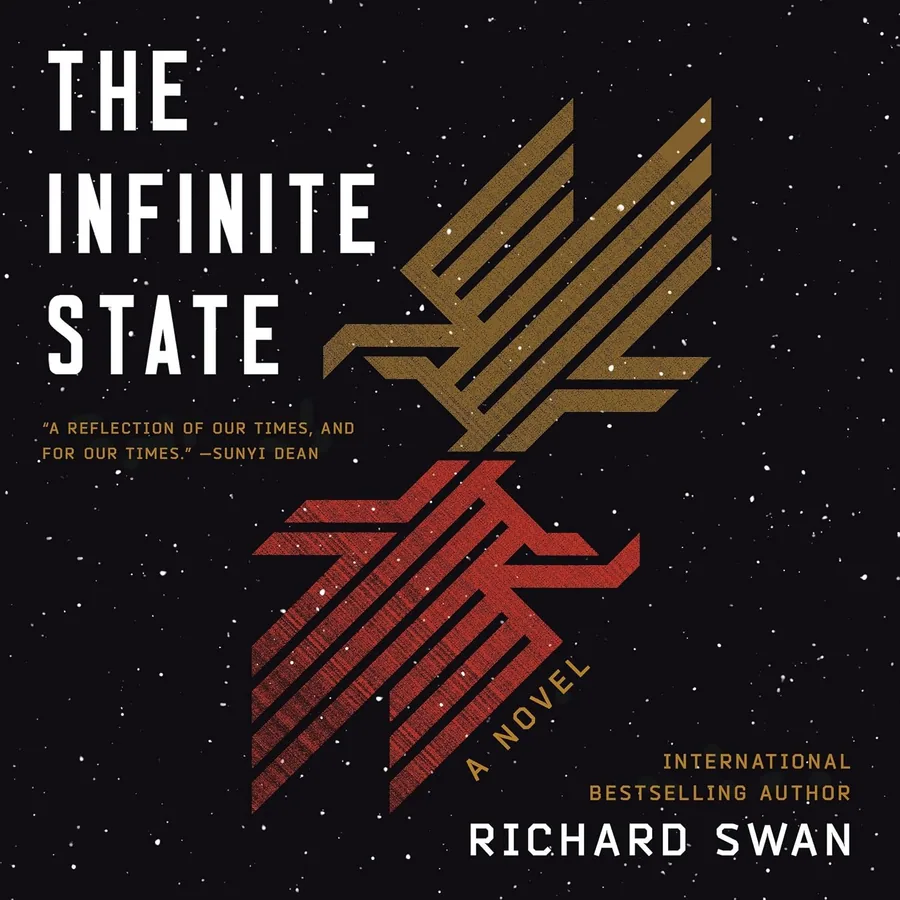
Every morning in the Decurion Empire begins with a call and response. Who gives you life. Who gives you purpose. Who gives you joy. The answer is the same two words every time, and Richard Swan repeats them often enough that by page fifty you are supplying them yourself before the question finishes. That is the whole book in miniature. The Empire does not need to watch every citizen. It has already installed itself in the grammar.
Katherine Fuller inherits at the worst possible moment for the party. Her husband was a senior man in Pater Aeternus, the governing body of the Empire, and his death leaves her holding a fortune the state never intended a woman to control. What she does with it drives the novel. She buys a world. An unsettled one, legally, through the Empire's own property statutes, and then she starts assembling the people who could run it. Not a rebellion. A colony with a constitution. Swan clearly understands that this is more threatening to a totalitarian state than a war fleet, and he works through the legal mechanics in enough detail that you believe she might pull it off, right up until you start counting how many people already know.
Two other viewpoints run alongside hers. A disgraced investigator, whose fall from the party's good graces has left him useful to people he would rather not owe anything to, and a hypersled pilot who works the thin slice of the Empire that surveillance can't fully reach, the transit lanes between systems. The pilot chapters carry the best hardware writing in the book. Swan is thorough about the machines and about what they do to the bodies strapped inside them, and he almost never drops a piece of jargon without immediately showing you a person it acts on. The investigator's sections do something different and just as good. They show what Decurion law looks like from inside the machinery, which is to say arbitrary, procedural, and completely sincere about itself.
What the three perspectives buy is calibration. The same regime lands on a rich widow, a fallen official, and a working pilot in three different registers, and the distance between those registers is the argument. Katherine can afford to think about political theory. The pilot can afford to think about her next contract. Swan does not treat that as a failure of nerve on the pilot's part, and he is careful in the same way about the gender machinery: the strict roles, the moral guidance, the constant pressure on party families to produce more citizens. It reads as a system with incentives rather than a costume, and that is most of the difference between a dystopia that works and one that is only a mood. The recruiting is where all of it bites hardest. Katherine has to find collaborators inside a society engineered so that informing on your neighbor is always the safest move available, and every conversation she has about the project doubles as a test she has no way to grade.
The furniture is familiar, and I doubt Swan would claim otherwise. Surveillance apparatus, catechism, forbidden interiority, a founding document circulating as contraband. Anyone who has read the twentieth century's big dystopias will recognize the beats, and the comparison readers keep reaching for, Orwell crossed with Atwood, is accurate enough to be a little limiting. The idiom sometimes works against the setting too. These are people raised inside a thousand-year theocratic empire, and now and then they think in cadences that sound like ours. Katherine in particular makes two or three choices in the opening third that are hard to square with a woman who has survived that long inside the party. She gets sharper. It takes a while.
Why you should read
- Dystopian science fiction with real political machinery
- Multi-POV epics that stay on a handful of worlds
- Readers who liked the bleak civics of 1984
- Detailed hardware grounded in what it costs a body
What to expect
- Three rotating viewpoints from very different classes
- Slow-building pressure rather than early action
- Dense technology and party procedure worked out properly
- Series opener that closes on an open question
What saves it is that the scale never swallows the story, which is the way most galactic-empire novels come apart. Swan keeps the map deliberately small. Almost all of The Infinite State happens across a handful of worlds and one very good ship, and instead of breadth he builds pressure, chapter by chapter, until the Empire noticing Katherine stops being a question of if and becomes a matter of scheduling. By the last hundred pages the live question is what her colony will have to turn into to survive contact with the thing it was founded to escape. Book one of the Decurion Saga sets that on the table and leaves it there. I want the second one now.