Where to read or listen
- Is there an audiobook of The Explosive Child?
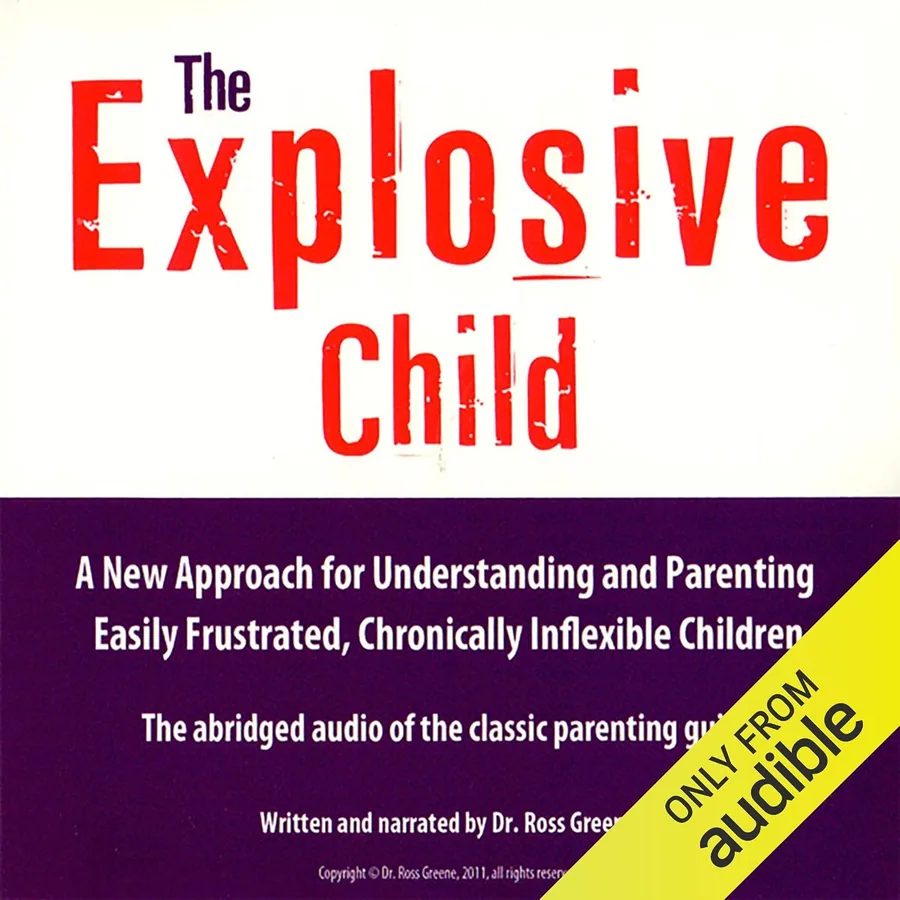
- Yes. The Explosive Child has an Audible audiobook edition, narrated by Dr. Ross W. Greene.Listen free with Audible
We earn from qualifying Amazon purchases.
- How long is the The Explosive Child audiobook?
- The The Explosive Child audiobook runs 2 hr 38 min.
- Is The Explosive Child on Kindle+?
- Yes. The Explosive Child was included with Kindle+ when we last checked on November 23, 2026.
Common questions
- What is The Explosive Child about?
- This is the parenting book to hand a worn-out parent in the middle of a bad month. Ross W. Greene wrote The Explosive Child for families whose kids meet ordinary frustrations with screaming, kicking, hitting, and broken property, and whose adults have already tried the standard toolkit of…
- Is The Explosive Child worth reading?
- We scored The Explosive Child 4.7 out of 5. The Explosive Child by Ross W. Greene is a parenting book for families of kids whose frustration turns into screaming, hitting, and wrecked rooms. It trades punishments and reward charts for Collaborative & Proactive Solutions, a plain method for solving problems with the child…
More like this
Related books

Raising Good Humans: A Mindful Guide to Breaking the Cycle of Reactive Parenting
Hunter Clarke-Fields MSAE

The Whole-Brain Child: 12 Revolutionary Strategies to Nurture Your Child's Developing Mind
Daniel J. Siegel M.D.

The Gardener and the Carpenter: What the New Science of Child Development Tells Us About the Relationship Between Parents and Children
Alison Gopnik

Good Inside: A Guide to Becoming the Parent You Want to Be
Becky Kennedy

The Philosophical Baby: What Children's Minds Tell Us About Truth, Love, and the Meaning of Life
Alison Gopnik

No-Drama Discipline: The Whole-Brain Way to Calm the Chaos and Nurture Your Child's Developing Mind
Daniel J. Siegel M.D.

Be Your Own Bestie: A No-Nonsense Guide to Changing the Way You Treat Yourself
Misha Brown

The 7 Habits of Highly Effective People
Stephen R. Covey

Deep Work: Rules for Focused Success in a Distracted World
Cal Newport

The Power of Habit: Why We Do What We Do in Life and Business
Charles Duhigg