Where to read or listen
- Is there an audiobook of The 4-Hour Body?
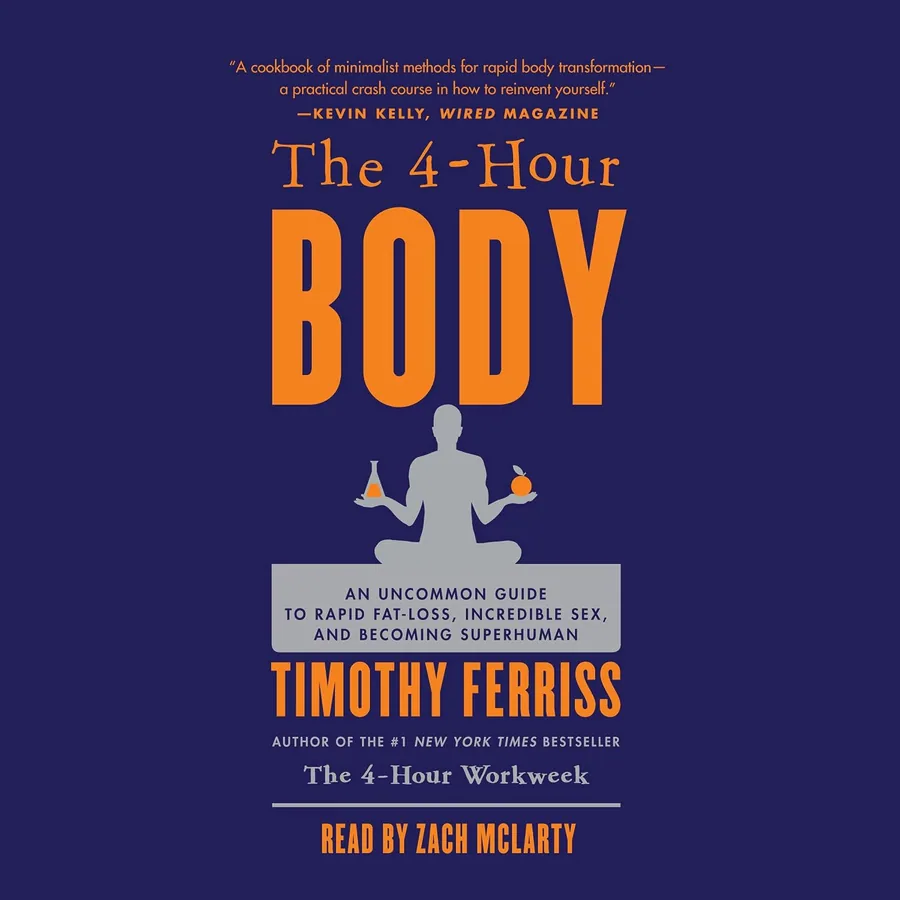
- Yes. The 4-Hour Body has an Audible audiobook edition, narrated by Zach McLarty.Listen free with Audible
We earn from qualifying Amazon purchases.
- How long is the The 4-Hour Body audiobook?
- The The 4-Hour Body audiobook runs 3 hr 51 min.
- Is The 4-Hour Body on Kindle+?
- No. The 4-Hour Body was not included with Kindle+ when we last checked on November 23, 2026.
More by Timothy FerrissSee every Timothy Ferriss book we've reviewed, with our scores.All Timothy Ferriss books →
Common questions
- What is The 4-Hour Body about?
- The 4-Hour Body reads less like a book than a workshop binder. At 683 pages it covers more than fifty topics, among them fat loss, muscle gain, sleep, running, injuries, and sex, and Timothy Ferriss built it in sections so a reader with one goal can go straight to the chapters that matter. That is…
- Is The 4-Hour Body worth reading?
- We scored The 4-Hour Body 4.5 out of 5. Timothy Ferriss's The 4-Hour Body is a sprawling health and fitness book of fat-loss, muscle-gain, and body-hacking experiments drawn from more than a decade of testing. It is organized so you can jump to the goal you care about, and its practical sections are easier to trust…
More like this
Related books

The 4-Hour Workweek
Timothy Ferriss

The Subtle Art of Not Giving a F*ck: A Counterintuitive Approach to Living a Good Life
Mark Manson

Grit: The Power of Passion and Perseverance
Angela Duckworth

Feeling Good: Overcome Depression and Anxiety with Proven Techniques
David D. Burns M.D.

How to Raise an Adult
Julie Lythcott-Haims

The Power of Now: A Guide to Spiritual Enlightenment
Eckhart Tolle

The Untethered Soul: The Journey Beyond Yourself
Michael A. Singer

How To Win Friends and Influence People
Dale Carnegie

Protocols: An Operating Manual for the Human Body
Andrew D. Huberman

Every Tool's a Hammer: Life Is What You Make It
Adam Savage