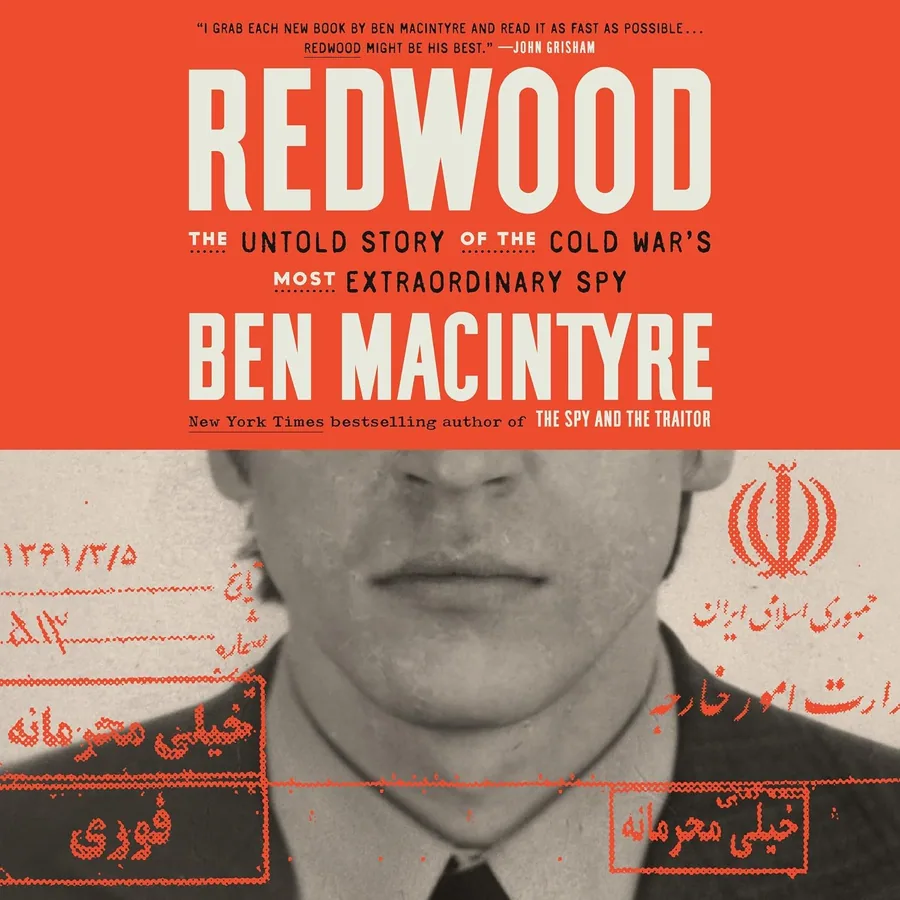
Where to read or listen
- Is there an audiobook of Redwood?
- Yes. Redwood has an Audible audiobook edition, narrated by Ben Macintyre.Listen free with Audible
We earn from qualifying Amazon purchases.
- How long is the Redwood audiobook?
- The Redwood audiobook runs 17 hr 24 min.
- Is Redwood on Kindle+?
- No. Redwood was not included with Kindle+ when we last checked on October 25, 2026.
- What formats is Redwood available in?
- On Amazon, Redwood comes as a Kindle ebook, a paperback and a hardcover.
Common questions
- What is Redwood: The Untold Story of the Cold War's Most Extraordinary Spy about?
- Vladimir Kuzichkin has a good job and a bad secret. In 1981 he is a KGB major, the best Soviet officer in Iran, running agents in Tehran and working with a hidden network of Iranian communists while the new Islamic regime settles in. What he wants is simple: his own side must never learn something…
- Is Redwood: The Untold Story of the Cold War's Most Extraordinary Spy worth reading?
- We scored Redwood: The Untold Story of the Cold War's Most Extraordinary Spy 4.5 out of 5. Redwood by Ben Macintyre is a Cold War spy history about KGB Major Vladimir Kuzichkin, who turns to MI6 in 1981 from his post in revolutionary Tehran. It's narrative nonfiction that reads like a thriller, and it follows the young British officer charged with getting him out…
More like this
Related books

Kissinger: A Biography
Walter Isaacson

Team of Rivals: The Political Genius of Abraham Lincoln
Doris Kearns Goodwin

Benjamin Franklin: An American Life
Walter Isaacson

Swan Song: Diana, My Sister
Charles Spencer

The Gales of November: The Untold Story of the Edmund Fitzgerald
John U. Bacon

Sapiens
Yuval Noah Harari

The Stranger Beside Me
Ann Rule

A Short History of Nearly Everything: #1 International Bestseller
Bill Bryson

The Boys in the Boat: Nine Americans and Their Epic Quest for Gold at the 1936 Berlin Olympics
Daniel James Brown

1929: Inside the Greatest Crash in Wall Street History
Andrew Ross Sorkin