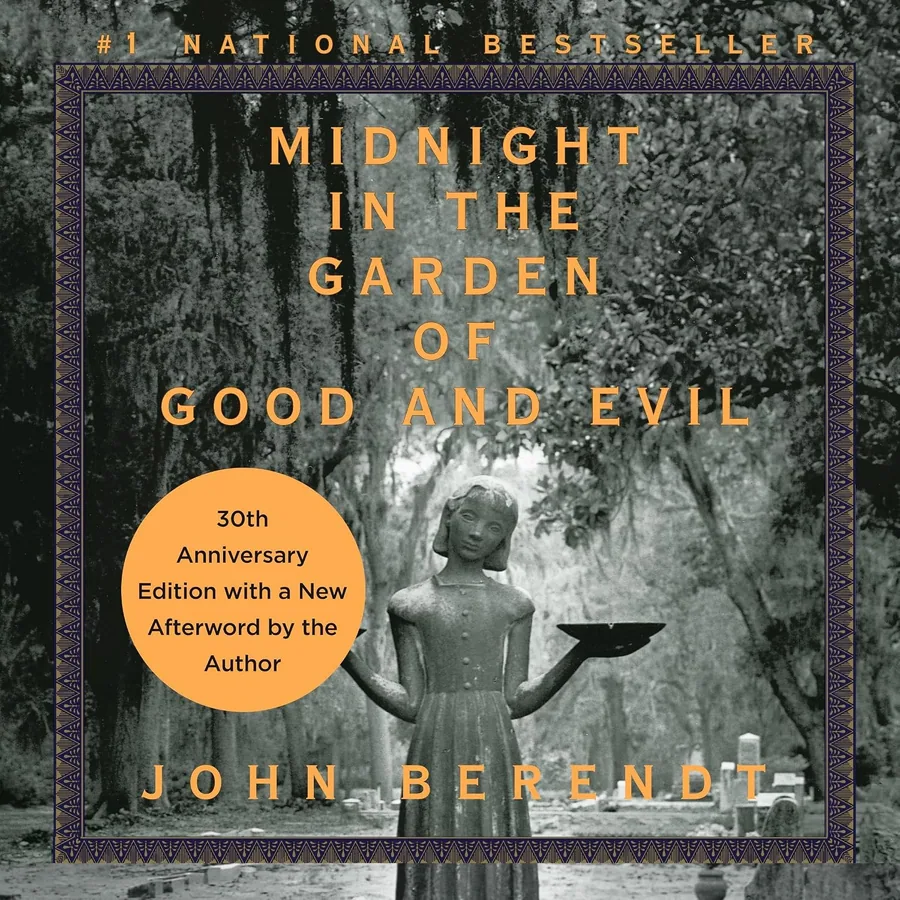
John Berendt's Midnight in the Garden of Good and Evil makes an argument that most true crime books never try: a murder tells you less about the killer than about the town that has to live with it. The crime here is a shooting inside the city's grandest house before dawn on May 2, 1981. The question is whether it was murder or self-defense, and the case dragged on for years. But the book keeps stepping sideways from the shooting, and the town keeps stepping in.
Berendt writes as a New York outsider who stays on, and the first-person voice is what holds the book together. He spent eight years in Savannah, and the research shows. The cast is a parade. A card club of well-bred society women. A drag queen named Chablis, whom readers cite more than anyone, one of them for laugh-out-loud moments. A voodoo priestess named Minerva who works in the graveyard at midnight. A recluse with a bottle of poison, a piano-playing con artist, a foul-mouthed aging Southern belle. Jim Williams, a wealthy antiques dealer, is the man charged in the killing of Danny Hansford, and Berendt gives him real space. Together they act like a chorus, commenting on the case and on each other.
The mystery is real, and it does what the best of them do. It asks which version to believe. Williams claims self-defense, the prosecution says murder, and it takes four trials to settle, which alone says the evidence refused a clean reading. One reader says what actually happened depends on the lens you choose, and that is the right way to describe the effect. Suspicion shifts depending on who is talking. The setup is a question, and Berendt keeps it open longer than most writers would dare.
The outsider's position matters. One reader picks up that Yankees don't seem welcome there, even though the writer is from New York. Berendt takes in the town without sneering at it, and he lets the oddballs talk. The result reads warmer than a typical case study and stranger than a travel memoir.
Savannah itself is the second main character. Readers say Berendt makes the city feel like its own person in the story, a place where everyone knows everyone else and good manners sit on top of a current of hostility. A good number of readers say they wanted to visit afterward, and some did. The book makes that plausible. It treats the city's gentility and its meaner side as one thing.
Now the fair complaints. The book can run slow. One reader found the pace leisurely enough that it took longer to finish than expected. Another, who came for a murder mystery, found the focus more on the writer's experience than on the crime. A third found it hard to keep track of characters. One reader grants that critics call the background material an info dump, though that reader never found it slow going. The book is not a fast procedural. Anyone expecting the shape of a crime show will feel shortchanged, and one reader says as much, calling it closer to a memoir.
That looseness is also the source of the book's charm. Berendt lingers on a debutante ball. The murder case is the backbone, but the flesh is gossip, manners, and money. If you read for plot alone, you may skim, as one early reader admits to doing. Slower, or on audio, the details land. That reader came back to the book after a visit and found it richer on a second pass.
Why you should read
- Narrative nonfiction with a strong sense of place
- Eccentric, funny characters in a Southern city
- True crime that cares as much about the town as the case
- Readers planning a trip to Savannah
What to expect
- A leisurely pace with long detours
- A first-person narrator who stays in the story
- A big cast that can be hard to track
- A murder case that unfolds over several trials
- Moral ambiguity rather than a tidy whodunit
The verdict is simple. As a true crime book it is unusual and sometimes frustrating. As a portrait of a city and its eccentrics it is hard to beat, and the murder case gives that portrait a spine it would otherwise lack. The ending to the story is worth finding out for yourself, and Savannah will stay with you after the last page.