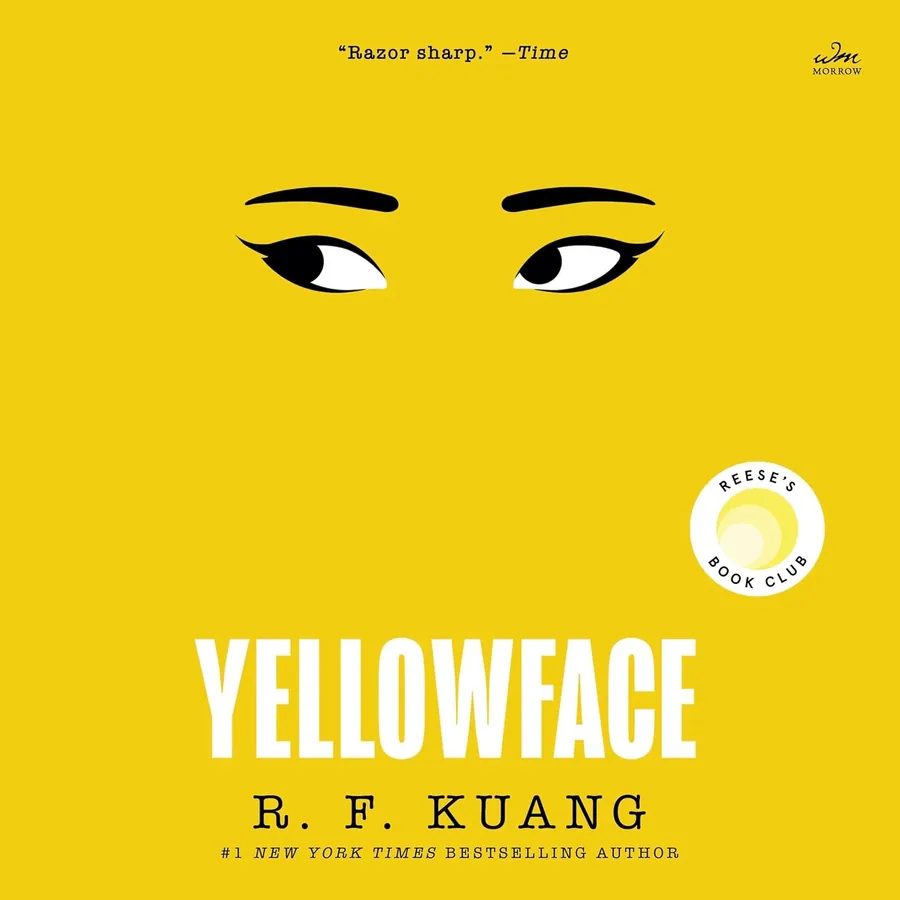
It starts with a crepe pan and a freak accident. June Hayward watches her brilliant, beautiful frenemy Athena Liu choke to death, and before the body's cold she's walking out the door with the only draft of Athena's unfinished novel tucked under her arm. From there Kuang does something genuinely difficult. She makes us live inside June's head while she rationalizes, polishes, and submits the stolen book as her own, and she keeps the voice so reasonable, so aggrieved, so sure it was owed something, that you catch yourself nodding along before you remember what she's actually doing. That's the engine of the whole book. The horror isn't supernatural. It's how easily a person talks herself into the indefensible, one small step at a time.
As a thriller, the tension here is less about whodunit than about when-she'll-get-caught, and Kuang is smart about keeping that dread simmering. Anonymous accounts start asking questions online. A detail in the manuscript doesn't quite belong to June. Athena keeps surfacing at the worst moments, real or imagined. The pacing stays propulsive, partly because June narrates in a clipped, anxious rhythm that reads like someone refreshing a feed she's afraid of. Where the novel is funniest, it's also the most exposed: the performative sensitivity, the marketing that wants an ethnically ambiguous author photo, the way an industry congratulates itself for diversity while treating writers of color as interchangeable assets. Those publishing scenes land hard. The recurring social-media set pieces are a mixed bag — Kuang flags online pile-ons as a central subject, but some of them read more like illustrated theses than scenes, with the takeaway delivered before you've finished reading.
Where the book is most alive is its argument with itself. Who gets to tell which stories? Does a piece of suppressed history deserve telling even by the wrong teller? Kuang doesn't hand you a clean answer, and she's careful to make June's grievances occasionally, uncomfortably, partly valid. The novel also resists turning Athena into a martyr; the more June digs, the less simple her dead friend looks, and that refusal to canonize anyone keeps the satire from flattening into a sermon.
The honest limitation is in the back half, and it's worth naming. Once the engine of guilt and exposure is established, the plot starts circling the same conflict. June commits a wrong, panics, doubles down, gets a fresh threat, repeats. The escalation is real but the emotional register starts to plateau, and June's monologuing occasionally tips from psychologically vivid into the author repeating a point she's already nailed. It's a book that trusts its themes more than its subtext.
Why you should read
- Readers who love a thoroughly unreliable first-person narrator
- Fans of satire aimed at publishing and online culture
- Anyone drawn to slow-burn dread over body counts
- Book clubs willing to argue about whether June is ever right
What to expect
- Fast, anxious first-person narration that rarely lets up
- Sharp industry satire mixed with psychological suspense
- A morally messy protagonist you're meant to distrust
- Escalating stakes built around a single moral crisis
And yet the ending earns its turn. Kuang resists tidiness and lets June stay exactly the person she's been all along, which is far more unsettling than any redemption arc would have been. You close it knowing you spent two hundred pages half-rooting for a thief, and the discomfort of having done that is precisely the point she wanted to leave you holding.