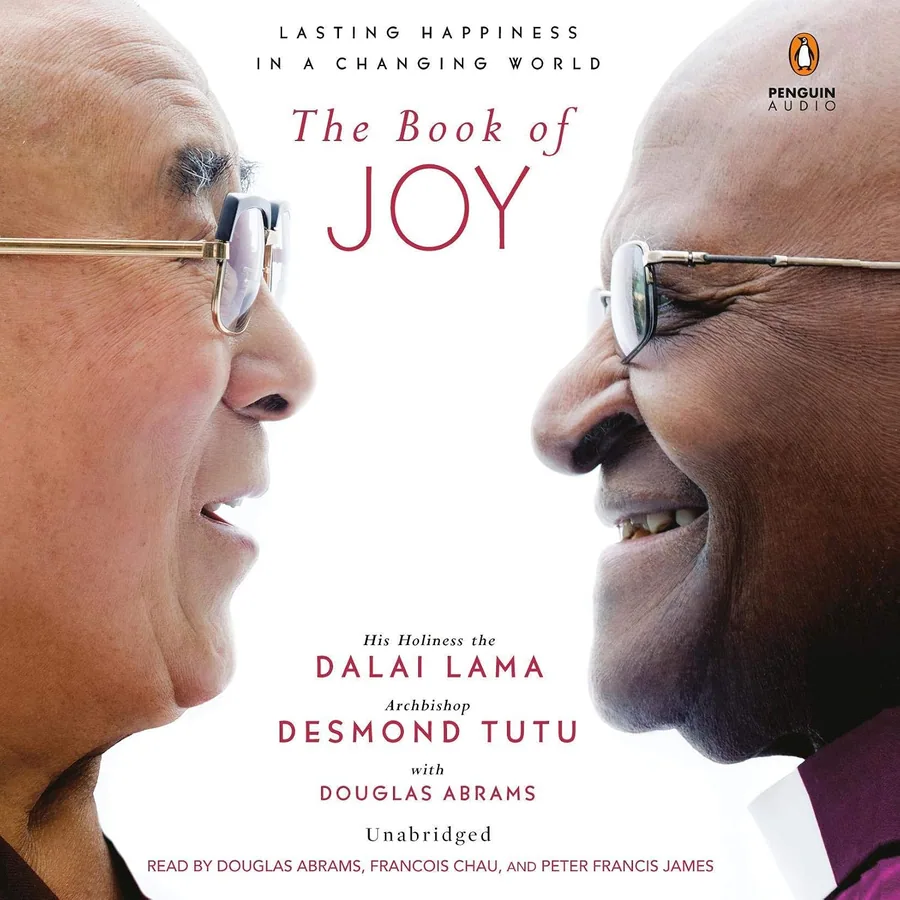
Where to read or listen
- Is there an audiobook of The Book of Joy: Lasting Happiness in a Changing World?
- Yes. The Book of Joy: Lasting Happiness in a Changing World has an Audible audiobook edition, narrated by Douglas Carlton Abrams, Francois Chau, and Peter Francis James.Listen free with Audible
We earn from qualifying Amazon purchases.
- How long is the The Book of Joy: Lasting Happiness in a Changing World audiobook?
- The The Book of Joy: Lasting Happiness in a Changing World audiobook runs 10 hr 12 min.
- Is The Book of Joy: Lasting Happiness in a Changing World on Kindle+?
- No. The Book of Joy: Lasting Happiness in a Changing World was not included with Kindle+ when we last checked on November 23, 2026.
Common questions
- What is The Book of Joy: Lasting Happiness in a Changing World about?
- The Book of Joy is better as a conversation than as a method, and that turns out to be the right call. The Dalai Lama and Archbishop Desmond Tutu got together in April 2015 in Dharamsala, India, where Tutu traveled to celebrate the Dalai Lama's eightieth birthday. They sat down for a week of talks…
- Is The Book of Joy: Lasting Happiness in a Changing World worth reading?
- We scored The Book of Joy: Lasting Happiness in a Changing World 4.6 out of 5. The Book of Joy by the Dalai Lama and Desmond Tutu records a week of conversation in Dharamsala about finding lasting happiness through suffering. It is a spiritual, self-help-adjacent book that works as warm company first and practical guidance second, with fear, anger, grief…
More like this
Related books

The Four Agreements: A Practical Guide to Personal Freedom
Don Miguel Ruiz

The Power of Now: A Guide to Spiritual Enlightenment
Eckhart Tolle

The Untethered Soul: The Journey Beyond Yourself
Michael A. Singer

Every Tool's a Hammer: Life Is What You Make It
Adam Savage

Tiny Habits: The Small Changes That Change Everything
BJ Fogg PhD

Range: Why Generalists Triumph in a Specialized World
David Epstein

Outliers: The Story of Success
Malcolm Gladwell

Mindset: The New Psychology of Success
Carol S. Dweck

Maybe You Should Talk To Someone: A Therapist, HER Therapist, and Our Lives Revealed
Lori Gottlieb

The Seven Principles for Making Marriage Work
John Gottman PhD