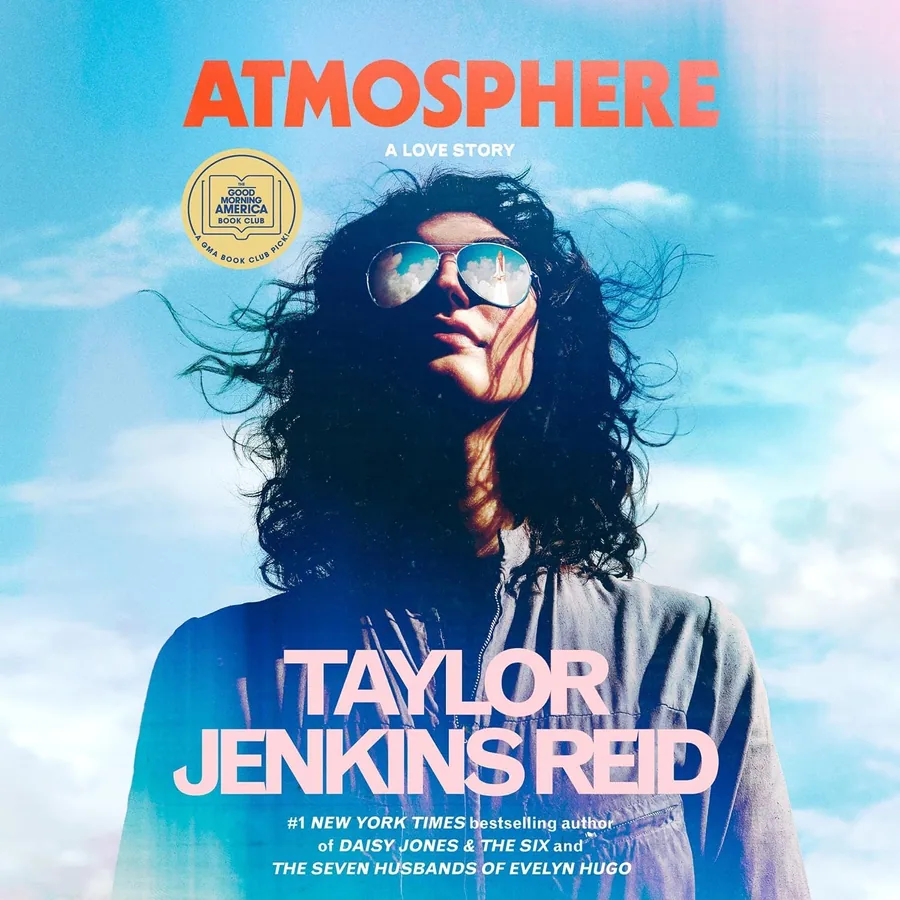
Where to read or listen
- Is there an audiobook of Atmosphere: A Love Story?
- Yes. Atmosphere: A Love Story has an Audible audiobook edition, narrated by Taylor Jenkins Reid, Kristen DiMercurio, and Julia Whelan.Listen free with Audible
We earn from qualifying Amazon purchases.
- How long is the Atmosphere: A Love Story audiobook?
- The Atmosphere: A Love Story audiobook runs 9 hr 52 min.
- Is Atmosphere: A Love Story on Kindle Unlimited?
- No. Atmosphere: A Love Story was not included with Kindle Unlimited when we last checked on September 27, 2026.
- What formats is Atmosphere: A Love Story available in?
- On Amazon, Atmosphere: A Love Story comes as a Kindle ebook, a paperback and a hardcover.
More by Taylor Jenkins ReidSee every Taylor Jenkins Reid book we've reviewed, with our scores.All Taylor Jenkins Reid books →
Common questions
- What is Atmosphere: A Love Story about?
- Before Joan Goodwin fills out the NASA application that upends her life, she's on a dark lawn with her niece Frances, naming stars. Joan is an astronomy professor at Rice, content and careful and a little walled-off, and she loves the sky the way some people love a faith they can practice alone…
- Is Atmosphere: A Love Story worth reading?
- We scored Atmosphere: A Love Story 4.6 out of 5. Taylor Jenkins Reid's Atmosphere follows Joan Goodwin, a reserved astronomy professor, into NASA's first class of women astronauts in the early 1980s, where the pull of space and an unexpected love with a fellow candidate rearrange everything she thought her life would hold…
Advertisement
More like this
Related books

There's Only One Sin in Hollywood: A Novel
Rasheed Newson

The Prophets
Robert Jones Jr.

The Castle in the Glen: A Novel
Rhys Bowen

Cutting for Stone
Abraham Verghese

The Tattooist of Auschwitz
Heather Morris

Keeper of Lost Children
Sadeqa Johnson

Land
Maggie O'Farrell

The Bright Sword: A Novel of King Arthur
Lev Grossman

Giovanni's Room
James Baldwin

Homegoing
Yaa Gyasi